
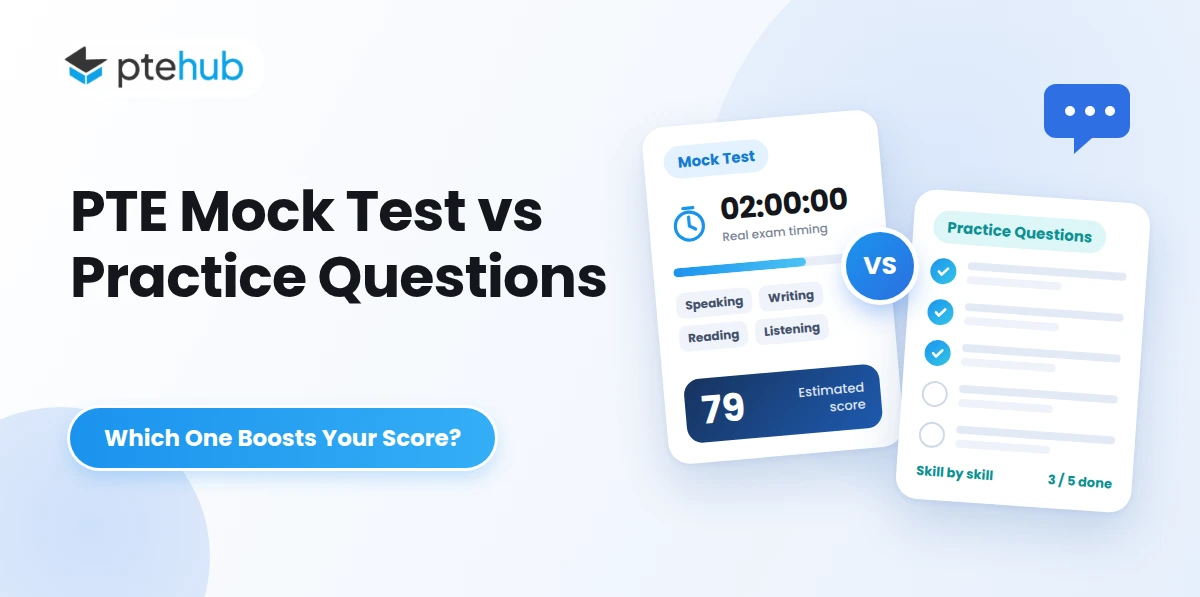
PTE Mock Test vs Practice Questions: What’s the Difference?

  • October 2, 2026
PTE Mock Test vs Practice Questions

Preparing for the PTE Academic exam involves more than answering questions repeatedly. Two of the most common preparation methods are PTE mock tests and PTE practice questions, but they serve different purposes.

PTE practice questions help you improve specific question types and skills, while a PTE mock test helps you practise the overall test experience under timed conditions. Using both can help you identify weaknesses, build familiarity with the test format, and practise managing your time.

PTE Mock Test vs Practice Questions: Quick Comparison

Feature PTE Mock Test PTE Practice Questions
Main purpose Simulate the test experience Improve specific tasks
Coverage Multiple sections and question types Usually individual question types
Timing Usually timed Flexible
Best for Checking overall readiness Targeted skill improvement
Repetition Limited by test structure Easy to repeat
Performance review Overall and task-level review Question-level review
Test-day simulation Yes No
Best stage Progress and final preparation Throughout preparation

The two methods are not alternatives in the strict sense. A mock test can show you where you need improvement, while practice questions give you a way to work on those weaknesses.

What Is a PTE Mock Test?

A PTE mock test is a practice test designed to reproduce important aspects of the PTE exam experience. Depending on the platform, it may include multiple sections and question types, time limits, and performance feedback.

A mock test is particularly useful for practising:
  • Time management
  • Moving between different question types
  • Maintaining concentration throughout a test
  • Answering under time pressure
  • Understanding your overall performance
  • Identifying weaker question types

A good mock test should reflect the current PTE Academic format and question types rather than relying on outdated exam patterns.

If you want to practise in an exam-style environment, you can try a PTE mock test online.

What Does a PTE Mock Test Tell You?

A mock test can help you identify patterns in your performance.

For example, you may discover that:
  • You perform well when practising individual questions but struggle with timing during a full test.
  • You regularly lose marks on certain task types.
  • You become less consistent toward the end of the test.
  • You need more practice with speaking fluency.
  • You need to improve your approach to particular reading or listening tasks.

The important point is that taking the mock test is only one part of the process. Analysing the result is what makes the test useful for future preparation.

What Are PTE Practice Questions?

PTE practice questions are individual PTE-style questions used to develop familiarity and improve performance on particular tasks.

Instead of completing a complete mock test, you can focus on one question type and repeat it several times.

Examples include:
  • Read Aloud
  • Repeat Sentence
  • Describe Image
  • Retell Lecture
  • Answer Short Question
  • Summarize Written Text
  • Write Essay
  • Reading question types
  • Listening question types

Practice questions are particularly useful when you know exactly which area you need to improve.

For example, if Repeat Sentence is difficult for you, you can practise multiple Repeat Sentence questions instead of completing another full mock test.

You can use PTE practice online to work on individual tasks and build familiarity with different question types.

PTE practice questions can also be used to work on specific skills, including PTE Speaking, PTE Writing, PTE Reading, and PTE Listening. For example, you can practise speaking tasks repeatedly, work on individual reading question types, improve writing responses, or focus on listening tasks where you are making frequent mistakes.

PTE Mock Test vs Practice Questions: Key Differences

1. Purpose

The biggest difference is the purpose of each method.

Practice questions are mainly for improvement. They allow you to focus on a specific task, identify mistakes, and repeat the task.

Mock tests are mainly for evaluation and simulation. They allow you to see how you perform when different tasks are combined under test-like conditions.

Practice questions → improve specific skills
Mock tests → check overall performance

2. Timing

Practice questions usually give you more flexibility. You can spend additional time reviewing an explanation, repeat a task, or stop when you need to.

Mock tests are more useful for practising under time pressure.

This matters because knowing how to answer a question is different from answering it accurately when the clock is running.

3. Coverage

Practice questions usually focus on individual question types.

A mock test covers a broader range of tasks, allowing you to experience changes between speaking, writing, reading, and listening activities.

This makes mock tests useful for understanding how your preparation works when several different tasks are combined.

4. Repetition

Practice questions are easier to repeat.

If you make the same mistake in a particular task, you can practise that task several times and focus on correcting the underlying problem.

Mock tests take more time, so repeating full tests without analysing your mistakes may not be the most productive use of preparation time.

5. Performance Review

Practice questions allow you to review a specific response.

A mock test gives you a broader view of your performance.

For example, a mock test may help you notice that your performance is generally strong but that one or two question types consistently cause problems.

That information can then guide your next practice session.

When Should You Use PTE Practice Questions?

Practice questions are useful throughout your PTE preparation.

You should consider using them when:
  • You are new to the PTE format.
  • You are learning a new question type.
  • You repeatedly make the same mistake.
  • You need to improve one particular skill.
  • You need more speaking practice.
  • You need to improve your writing responses.
  • You are struggling with a particular reading or listening task.
  • You want to practise without completing a full test.

For beginners, practice questions can help build familiarity before moving into longer exam-style sessions.

You can also use PTE preparation materials to support targeted study and revision.

When Should You Take a PTE Mock Test?

You can introduce mock tests once you understand the main question types and want to see how you perform in a broader test environment.

A mock test can be useful:
  • After learning the PTE format
  • After completing targeted practice
  • When checking your progress
  • When practising time management
  • During the later stages of preparation
  • Before your actual test

There is no universal number of mock tests that every candidate needs. Your preparation time, current ability, target score and weaknesses should influence how often you take them.

A useful approach is to take a mock test, analyse the result, and then return to targeted practice.

Are PTE Mock Tests Better Than Practice Questions?

PTE mock tests are not simply better than practice questions because they have different purposes.

Practice questions are useful for improving individual tasks, while mock tests are useful for practising the broader test experience and identifying weaknesses.

If you do not understand a question type: practise individual questions.
If you understand the question type but struggle with timing: use mock-test practice.
If you keep making the same mistake: return to targeted practice.
If you want to evaluate your overall preparation: take a mock test.

The most useful approach is often to use the two methods together.

Can You Prepare for PTE Using Only Practice Questions?

You can use practice questions as a major part of your preparation, but they do not reproduce every aspect of completing a broader test.

Using only individual questions may give you less experience with:

  • Managing the overall test pace
  • Moving between different task types
  • Maintaining concentration for longer periods
  • Managing time across multiple sections
  • Handling a sequence of different tasks

This does not mean that practice questions are ineffective. It means they serve a different purpose from a full mock test.

Can You Prepare for PTE Using Only Mock Tests?

Mock tests can help you understand your overall performance, but taking mock tests alone does not automatically correct your weaknesses.

Suppose a mock test shows that you consistently struggle with Repeat Sentence. Taking another complete mock may show the same problem again.

Instead, you can use the result to identify the weakness and then complete targeted Repeat Sentence practice.

Mock test → Identify weakness → Targeted practice → Review → Mock test

How to Combine PTE Mock Tests and Practice Questions

Step 1: Learn the PTE format

Understand the current question types, instructions, and timing requirements.

Step 2: Practise individual question types

Start with targeted practice rather than immediately relying on full mock tests.

Step 3: Take a mock test

Once you are familiar with the tasks, complete a mock test under timed conditions.

Step 4: Analyse your performance

Look beyond the final score.

Identify:
  • Weak question types
  • Repeated mistakes
  • Timing problems
  • Speaking issues
  • Writing problems
  • Reading or listening difficulties

Step 5: Return to targeted practice

Use practice questions to work on the weaknesses identified in the mock test.

Step 6: Take another mock test

After targeted practice, another mock test can help you review your overall performance.

Step 7: Repeat the cycle

Continue adjusting your practice based on what your results show.

This approach makes each mock test part of a larger preparation process rather than treating every mock as an isolated test.

Example: Using Both Methods During PTE Preparation

Imagine a candidate completes a PTE mock test and notices that Repeat Sentence and Describe Image are more difficult than other speaking tasks.

Instead of immediately taking another full mock test, the candidate could:

  1. Review the responses.
  2. Identify the specific mistakes.
  3. Practise Repeat Sentence questions.
  4. Practise Describe Image questions.
  5. Work on fluency and response structure.
  6. Review the new practice responses.
  7. Take another mock test later.

The mock test identifies the problem, while targeted practice provides an opportunity to work on it.

How to Analyse a PTE Mock Test

A mock test becomes more useful when you review the result carefully.

After finishing a mock test, ask yourself:

Which question types caused problems?

Look for patterns instead of focusing on one difficult question.

Which mistakes were repeated?

Repeated mistakes may indicate an area that needs targeted practice.

Did you run out of time?

If timing was a problem, review how much time you spent on different tasks.

Was your speaking performance consistent?

Check whether fluency, pronunciation, or hesitation affected your responses.

Did you understand why an answer was wrong?

Knowing the reason behind a mistake is more useful than simply seeing that an answer was incorrect.

What should you practise next?

Turn the mock-test result into a practical study plan.

You can also use the PTE Score Calculator to review and understand your score information.

6 Common Mistakes When Using PTE Practice Questions

1. Practising Without Reviewing Mistakes

Answering more questions does not automatically solve the reason behind an error. Review your responses and understand what needs to change.

2. Practising Only Easy Questions

Easy questions can build confidence, but preparation should also address areas where you consistently struggle.

3. Ignoring Weak Question Types

If a particular task repeatedly causes problems, give it targeted attention instead of avoiding it.

4. Focusing Only on Question Volume

Completing a large number of questions is not the same as learning from them.

5. Using Outdated Practice Material

PTE preparation resources should reflect the current test format and task types.

6. Memorising Without Understanding

Templates and strategies can be useful, but you should understand how and when to apply them rather than relying on memorised responses.

6 Common Mistakes When Taking PTE Mock Tests

1. Taking Mocks Without Preparation

A mock test can be useful even early in preparation, but candidates should understand that an early result may mainly show their starting point.

2. Treating the Mock Score as an Exact Prediction

A mock-test result should not automatically be treated as an exact prediction of the official PTE score.

3. Taking Mocks Without Analysing Them

Completing another test without reviewing previous mistakes can make it harder to identify what needs improvement.

4. Ignoring Individual Tasks

An overall result can hide weaknesses in particular question types.

5. Not Practising Under Timed Conditions

If timing is one of your weaknesses, practice should include realistic time limits.

6. Using Low-Quality or Outdated Tests

The usefulness of a mock test depends partly on how closely its content and structure reflect the current PTE exam.

How Many PTE Practice Questions Should You Do?

There is no single number of practice questions that is right for every candidate.

The amount you need can depend on:

  • Your current English ability
  • Your target score
  • Your preparation time
  • Your familiarity with PTE
  • Your weaker question types
  • Your mock-test performance

Instead of focusing only on the number of questions completed, focus on whether your practice is helping you understand and correct repeated mistakes.

How Many PTE Mock Tests Should You Take?

There is also no universal number of mock tests that every candidate needs.

A candidate who is new to PTE may need more time learning individual tasks before relying heavily on full mock tests. A candidate who already understands the format may use mock tests more regularly to review timing and overall performance.

The important part is to analyse each mock test and use the result to guide your next practice session.

What Should You Do After a PTE Mock Test?

Use a simple four-step process:

Review → Identify → Practise → Retest

Review

Look at your performance and responses.

Identify

Find the question types and skills that need attention.

Practise

Use targeted practice questions to work on those areas.

Retest

Take another mock test when you are ready to check your overall performance again.

This approach helps connect mock tests with actual learning.

PTE Mock Test vs Practice Questions: Which Should You Start With?

The answer depends on your preparation stage.

Your Situation Useful Focus
New to PTE Learn the format and practise individual questions
Learning task types Targeted practice questions
Checking progress Mock test + error analysis
Struggling with specific tasks Targeted practice
Preparing for test conditions Mock tests
Near test day Mock tests + targeted revision

Rather than choosing one method permanently, use each one for the purpose it serves.

A Practical PTE Preparation Approach

Learn → Practise → Test → Analyse → Improve → Test Again

Start by understanding the PTE format. Use practice questions to build task-specific skills, then use mock tests to check how those skills perform under broader test conditions.

After each mock test, return to targeted practice where necessary.

For candidates who want structured preparation, a PTE online course can also provide a more organised study path.

Conclusion

The difference between a PTE mock test and practice questions comes down to their purpose.

PTE practice questions are mainly used to improve specific question types and skills. PTE mock tests are used to practise the wider test experience, timing, and overall performance.

You do not necessarily have to choose between them. A practical preparation cycle is:

Practise individual tasks → Take a mock test → Analyse mistakes → Practise weak areas → Take another mock test

The goal is not simply to complete as many questions or mock tests as possible. The goal is to understand your mistakes and use each practice session to address them.

Frequently Asked Questions

What is the difference between a PTE mock test and practice questions?
A PTE mock test simulates a broader test experience, while practice questions focus on individual tasks or question types.
Is a PTE mock test harder than practice questions?
Not necessarily. A mock test can feel more demanding because it combines different tasks and usually involves time pressure.
Are PTE practice questions enough to prepare for the exam?
Practice questions are useful for targeted improvement, but mock tests can add experience with broader test conditions.
When should I start taking PTE mock tests?
You can start after becoming familiar with the main question types, then use mock tests to check progress and practise timing.
How often should I take a PTE mock test?
There is no fixed number. Base the frequency on your preparation stage, performance and the weaknesses identified in previous tests.
Can practice questions improve PTE performance?
Targeted practice can help you become more familiar with question types and work on specific weaknesses.
Should I take a mock test before practising PTE questions?
A mock test can be useful as an initial assessment, but you can also begin with question-level practice if you are completely new to PTE.
What should I do after a PTE mock test?
Review the result, identify repeated weaknesses, practise those areas, and use another mock test later to review your overall performance.
Are PTE mock-test scores accurate?
Mock scores should be treated as practice indicators rather than guaranteed predictions of your official PTE score.
Where can I practise PTE questions online?
You can use PTE Practice Online to practise different PTE question types.

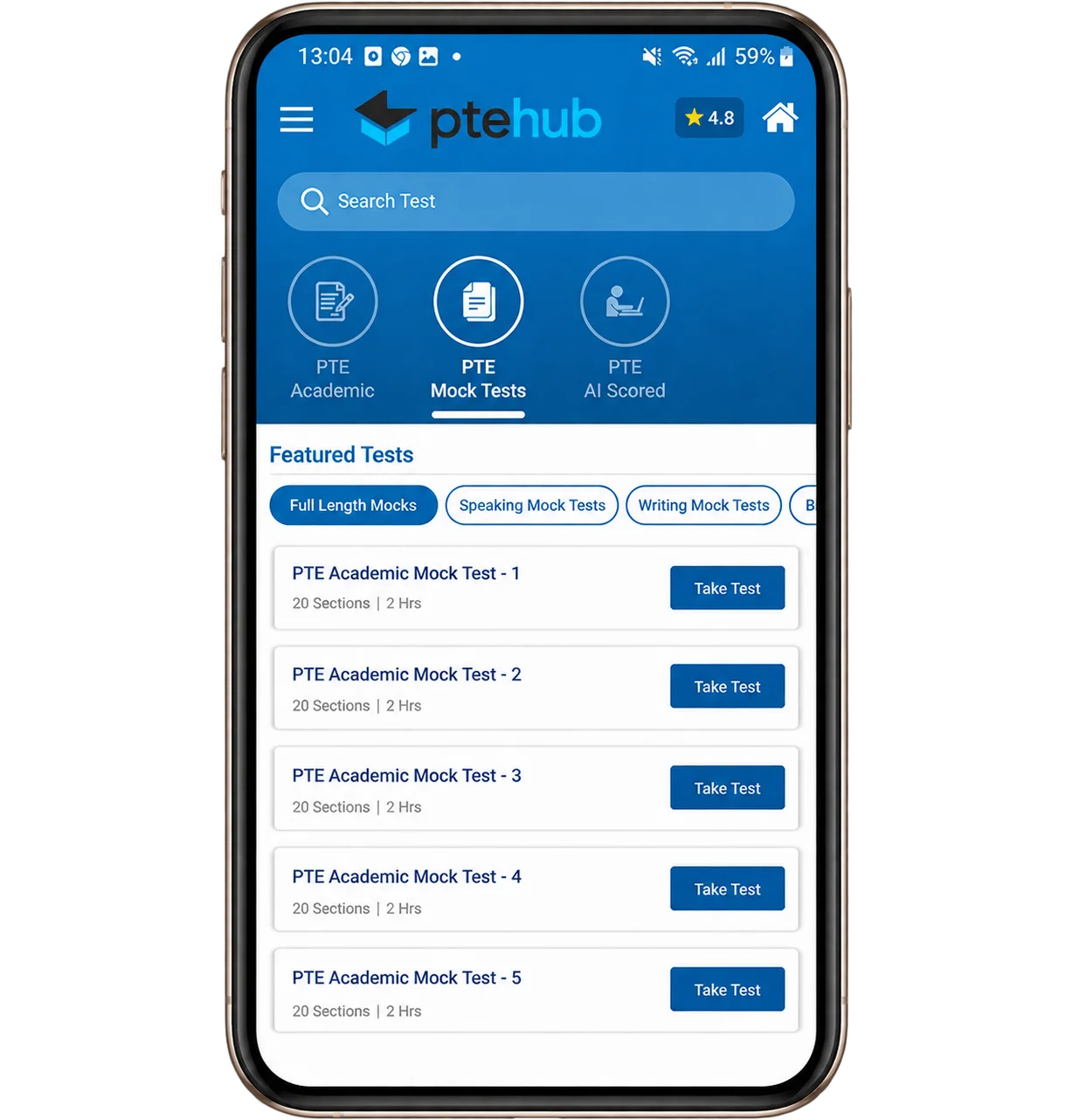
Practice on the PTEHub App

Prepare anywhere, anytime with real exam-like questions, instant AI scoring, and detailed performance insights directly on your mobile device.

PTEHub Mobile App

You May Also Like

Understanding how PTE scoring works can help you prepare more effectively, set realistic score targets, and identify areas that need...
Are you getting a lower PTE Speaking score than expected, even after hours of practice? You may be speaking too...
PTE Describe Image is an important task in the PTE Academic Speaking section. It tests your ability to understand visual...
  If your PTE Speaking score is not improving despite regular practice, you might be wondering what you are doing...

Tags:

Share:

PTE Mock Test vs Practice Questions

Preparing for the PTE Academic exam involves more than answering questions repeatedly. Two of the most common preparation methods are PTE mock tests and PTE practice questions, but they serve different purposes.

PTE practice questions help you improve specific question types and skills, while a PTE mock test helps you practise the overall test experience under timed conditions. Using both can help you identify weaknesses, build familiarity with the test format, and practise managing your time.

PTE Mock Test vs Practice Questions: Quick Comparison

Feature PTE Mock Test PTE Practice Questions
Main purpose Simulate the test experience Improve specific tasks
Coverage Multiple sections and question types Usually individual question types
Timing Usually timed Flexible
Best for Checking overall readiness Targeted skill improvement
Repetition Limited by test structure Easy to repeat
Performance review Overall and task-level review Question-level review
Test-day simulation Yes No
Best stage Progress and final preparation Throughout preparation

The two methods are not alternatives in the strict sense. A mock test can show you where you need improvement, while practice questions give you a way to work on those weaknesses.

What Is a PTE Mock Test?

A PTE mock test is a practice test designed to reproduce important aspects of the PTE exam experience. Depending on the platform, it may include multiple sections and question types, time limits, and performance feedback.

A mock test is particularly useful for practising:
  • Time management
  • Moving between different question types
  • Maintaining concentration throughout a test
  • Answering under time pressure
  • Understanding your overall performance
  • Identifying weaker question types

A good mock test should reflect the current PTE Academic format and question types rather than relying on outdated exam patterns.

If you want to practise in an exam-style environment, you can try a PTE mock test online.

What Does a PTE Mock Test Tell You?

A mock test can help you identify patterns in your performance.

For example, you may discover that:
  • You perform well when practising individual questions but struggle with timing during a full test.
  • You regularly lose marks on certain task types.
  • You become less consistent toward the end of the test.
  • You need more practice with speaking fluency.
  • You need to improve your approach to particular reading or listening tasks.

The important point is that taking the mock test is only one part of the process. Analysing the result is what makes the test useful for future preparation.

What Are PTE Practice Questions?

PTE practice questions are individual PTE-style questions used to develop familiarity and improve performance on particular tasks.

Instead of completing a complete mock test, you can focus on one question type and repeat it several times.

Examples include:
  • Read Aloud
  • Repeat Sentence
  • Describe Image
  • Retell Lecture
  • Answer Short Question
  • Summarize Written Text
  • Write Essay
  • Reading question types
  • Listening question types

Practice questions are particularly useful when you know exactly which area you need to improve.

For example, if Repeat Sentence is difficult for you, you can practise multiple Repeat Sentence questions instead of completing another full mock test.

You can use PTE practice online to work on individual tasks and build familiarity with different question types.

PTE practice questions can also be used to work on specific skills, including PTE Speaking, PTE Writing, PTE Reading, and PTE Listening. For example, you can practise speaking tasks repeatedly, work on individual reading question types, improve writing responses, or focus on listening tasks where you are making frequent mistakes.

PTE Mock Test vs Practice Questions: Key Differences

1. Purpose

The biggest difference is the purpose of each method.

Practice questions are mainly for improvement. They allow you to focus on a specific task, identify mistakes, and repeat the task.

Mock tests are mainly for evaluation and simulation. They allow you to see how you perform when different tasks are combined under test-like conditions.

Practice questions → improve specific skills
Mock tests → check overall performance

2. Timing

Practice questions usually give you more flexibility. You can spend additional time reviewing an explanation, repeat a task, or stop when you need to.

Mock tests are more useful for practising under time pressure.

This matters because knowing how to answer a question is different from answering it accurately when the clock is running.

3. Coverage

Practice questions usually focus on individual question types.

A mock test covers a broader range of tasks, allowing you to experience changes between speaking, writing, reading, and listening activities.

This makes mock tests useful for understanding how your preparation works when several different tasks are combined.

4. Repetition

Practice questions are easier to repeat.

If you make the same mistake in a particular task, you can practise that task several times and focus on correcting the underlying problem.

Mock tests take more time, so repeating full tests without analysing your mistakes may not be the most productive use of preparation time.

5. Performance Review

Practice questions allow you to review a specific response.

A mock test gives you a broader view of your performance.

For example, a mock test may help you notice that your performance is generally strong but that one or two question types consistently cause problems.

That information can then guide your next practice session.

When Should You Use PTE Practice Questions?

Practice questions are useful throughout your PTE preparation.

You should consider using them when:
  • You are new to the PTE format.
  • You are learning a new question type.
  • You repeatedly make the same mistake.
  • You need to improve one particular skill.
  • You need more speaking practice.
  • You need to improve your writing responses.
  • You are struggling with a particular reading or listening task.
  • You want to practise without completing a full test.

For beginners, practice questions can help build familiarity before moving into longer exam-style sessions.

You can also use PTE preparation materials to support targeted study and revision.

When Should You Take a PTE Mock Test?

You can introduce mock tests once you understand the main question types and want to see how you perform in a broader test environment.

A mock test can be useful:
  • After learning the PTE format
  • After completing targeted practice
  • When checking your progress
  • When practising time management
  • During the later stages of preparation
  • Before your actual test

There is no universal number of mock tests that every candidate needs. Your preparation time, current ability, target score and weaknesses should influence how often you take them.

A useful approach is to take a mock test, analyse the result, and then return to targeted practice.

Are PTE Mock Tests Better Than Practice Questions?

PTE mock tests are not simply better than practice questions because they have different purposes.

Practice questions are useful for improving individual tasks, while mock tests are useful for practising the broader test experience and identifying weaknesses.

If you do not understand a question type: practise individual questions.
If you understand the question type but struggle with timing: use mock-test practice.
If you keep making the same mistake: return to targeted practice.
If you want to evaluate your overall preparation: take a mock test.

The most useful approach is often to use the two methods together.

Can You Prepare for PTE Using Only Practice Questions?

You can use practice questions as a major part of your preparation, but they do not reproduce every aspect of completing a broader test.

Using only individual questions may give you less experience with:

  • Managing the overall test pace
  • Moving between different task types
  • Maintaining concentration for longer periods
  • Managing time across multiple sections
  • Handling a sequence of different tasks

This does not mean that practice questions are ineffective. It means they serve a different purpose from a full mock test.

Can You Prepare for PTE Using Only Mock Tests?

Mock tests can help you understand your overall performance, but taking mock tests alone does not automatically correct your weaknesses.

Suppose a mock test shows that you consistently struggle with Repeat Sentence. Taking another complete mock may show the same problem again.

Instead, you can use the result to identify the weakness and then complete targeted Repeat Sentence practice.

Mock test → Identify weakness → Targeted practice → Review → Mock test

How to Combine PTE Mock Tests and Practice Questions

Step 1: Learn the PTE format

Understand the current question types, instructions, and timing requirements.

Step 2: Practise individual question types

Start with targeted practice rather than immediately relying on full mock tests.

Step 3: Take a mock test

Once you are familiar with the tasks, complete a mock test under timed conditions.

Step 4: Analyse your performance

Look beyond the final score.

Identify:
  • Weak question types
  • Repeated mistakes
  • Timing problems
  • Speaking issues
  • Writing problems
  • Reading or listening difficulties

Step 5: Return to targeted practice

Use practice questions to work on the weaknesses identified in the mock test.

Step 6: Take another mock test

After targeted practice, another mock test can help you review your overall performance.

Step 7: Repeat the cycle

Continue adjusting your practice based on what your results show.

This approach makes each mock test part of a larger preparation process rather than treating every mock as an isolated test.

Example: Using Both Methods During PTE Preparation

Imagine a candidate completes a PTE mock test and notices that Repeat Sentence and Describe Image are more difficult than other speaking tasks.

Instead of immediately taking another full mock test, the candidate could:

  1. Review the responses.
  2. Identify the specific mistakes.
  3. Practise Repeat Sentence questions.
  4. Practise Describe Image questions.
  5. Work on fluency and response structure.
  6. Review the new practice responses.
  7. Take another mock test later.

The mock test identifies the problem, while targeted practice provides an opportunity to work on it.

How to Analyse a PTE Mock Test

A mock test becomes more useful when you review the result carefully.

After finishing a mock test, ask yourself:

Which question types caused problems?

Look for patterns instead of focusing on one difficult question.

Which mistakes were repeated?

Repeated mistakes may indicate an area that needs targeted practice.

Did you run out of time?

If timing was a problem, review how much time you spent on different tasks.

Was your speaking performance consistent?

Check whether fluency, pronunciation, or hesitation affected your responses.

Did you understand why an answer was wrong?

Knowing the reason behind a mistake is more useful than simply seeing that an answer was incorrect.

What should you practise next?

Turn the mock-test result into a practical study plan.

You can also use the PTE Score Calculator to review and understand your score information.

6 Common Mistakes When Using PTE Practice Questions

1. Practising Without Reviewing Mistakes

Answering more questions does not automatically solve the reason behind an error. Review your responses and understand what needs to change.

2. Practising Only Easy Questions

Easy questions can build confidence, but preparation should also address areas where you consistently struggle.

3. Ignoring Weak Question Types

If a particular task repeatedly causes problems, give it targeted attention instead of avoiding it.

4. Focusing Only on Question Volume

Completing a large number of questions is not the same as learning from them.

5. Using Outdated Practice Material

PTE preparation resources should reflect the current test format and task types.

6. Memorising Without Understanding

Templates and strategies can be useful, but you should understand how and when to apply them rather than relying on memorised responses.

6 Common Mistakes When Taking PTE Mock Tests

1. Taking Mocks Without Preparation

A mock test can be useful even early in preparation, but candidates should understand that an early result may mainly show their starting point.

2. Treating the Mock Score as an Exact Prediction

A mock-test result should not automatically be treated as an exact prediction of the official PTE score.

3. Taking Mocks Without Analysing Them

Completing another test without reviewing previous mistakes can make it harder to identify what needs improvement.

4. Ignoring Individual Tasks

An overall result can hide weaknesses in particular question types.

5. Not Practising Under Timed Conditions

If timing is one of your weaknesses, practice should include realistic time limits.

6. Using Low-Quality or Outdated Tests

The usefulness of a mock test depends partly on how closely its content and structure reflect the current PTE exam.

How Many PTE Practice Questions Should You Do?

There is no single number of practice questions that is right for every candidate.

The amount you need can depend on:

  • Your current English ability
  • Your target score
  • Your preparation time
  • Your familiarity with PTE
  • Your weaker question types
  • Your mock-test performance

Instead of focusing only on the number of questions completed, focus on whether your practice is helping you understand and correct repeated mistakes.

How Many PTE Mock Tests Should You Take?

There is also no universal number of mock tests that every candidate needs.

A candidate who is new to PTE may need more time learning individual tasks before relying heavily on full mock tests. A candidate who already understands the format may use mock tests more regularly to review timing and overall performance.

The important part is to analyse each mock test and use the result to guide your next practice session.

What Should You Do After a PTE Mock Test?

Use a simple four-step process:

Review → Identify → Practise → Retest

Review

Look at your performance and responses.

Identify

Find the question types and skills that need attention.

Practise

Use targeted practice questions to work on those areas.

Retest

Take another mock test when you are ready to check your overall performance again.

This approach helps connect mock tests with actual learning.

PTE Mock Test vs Practice Questions: Which Should You Start With?

The answer depends on your preparation stage.

Your Situation Useful Focus
New to PTE Learn the format and practise individual questions
Learning task types Targeted practice questions
Checking progress Mock test + error analysis
Struggling with specific tasks Targeted practice
Preparing for test conditions Mock tests
Near test day Mock tests + targeted revision

Rather than choosing one method permanently, use each one for the purpose it serves.

A Practical PTE Preparation Approach

Learn → Practise → Test → Analyse → Improve → Test Again

Start by understanding the PTE format. Use practice questions to build task-specific skills, then use mock tests to check how those skills perform under broader test conditions.

After each mock test, return to targeted practice where necessary.

For candidates who want structured preparation, a PTE online course can also provide a more organised study path.

Conclusion

The difference between a PTE mock test and practice questions comes down to their purpose.

PTE practice questions are mainly used to improve specific question types and skills. PTE mock tests are used to practise the wider test experience, timing, and overall performance.

You do not necessarily have to choose between them. A practical preparation cycle is:

Practise individual tasks → Take a mock test → Analyse mistakes → Practise weak areas → Take another mock test

The goal is not simply to complete as many questions or mock tests as possible. The goal is to understand your mistakes and use each practice session to address them.

Frequently Asked Questions

What is the difference between a PTE mock test and practice questions?
A PTE mock test simulates a broader test experience, while practice questions focus on individual tasks or question types.
Is a PTE mock test harder than practice questions?
Not necessarily. A mock test can feel more demanding because it combines different tasks and usually involves time pressure.
Are PTE practice questions enough to prepare for the exam?
Practice questions are useful for targeted improvement, but mock tests can add experience with broader test conditions.
When should I start taking PTE mock tests?
You can start after becoming familiar with the main question types, then use mock tests to check progress and practise timing.
How often should I take a PTE mock test?
There is no fixed number. Base the frequency on your preparation stage, performance and the weaknesses identified in previous tests.
Can practice questions improve PTE performance?
Targeted practice can help you become more familiar with question types and work on specific weaknesses.
Should I take a mock test before practising PTE questions?
A mock test can be useful as an initial assessment, but you can also begin with question-level practice if you are completely new to PTE.
What should I do after a PTE mock test?
Review the result, identify repeated weaknesses, practise those areas, and use another mock test later to review your overall performance.
Are PTE mock-test scores accurate?
Mock scores should be treated as practice indicators rather than guaranteed predictions of your official PTE score.
Where can I practise PTE questions online?
You can use PTE Practice Online to practise different PTE question types.

Tags:

Share:

Leave A Reply

Your email address will not be published. Required fields are marked *