

PTE Study Plan for 30 Days: Daily Practice for All Four Skills

  • November 19, 2026
PTE Study Plan for 30 Days


Preparing for the PTE Academic exam in 30 days is possible with a structured study plan, consistent practice, and regular performance evaluation. However, simply practising questions every day is not enough. You need to understand the exam format, identify your weaknesses, improve your English skills, and develop strategies for completing each task within the time limit.

A well-organised 30-day PTE study plan helps you divide your preparation into manageable daily tasks while balancing Speaking, Writing, Reading, and Listening. Instead of practising randomly, you can focus on specific skills each week, track your progress, and adjust your preparation according to your mock test results.

Whether you are preparing for your first PTE Academic exam or trying to improve your previous score, this one-month plan will help you build a consistent practice routine.


Can You Prepare for PTE in 30 Days?

Yes, you can make meaningful progress in 30 days if you follow a focused preparation routine. However, your results will depend on your current English proficiency, familiarity with the PTE test format, target score, and the amount of time you can dedicate to practice each day.

Students who already have a strong English foundation may use 30 days to improve task strategies, accuracy, fluency, and time management. Students who are less confident in English may need to spend more time strengthening vocabulary, grammar, pronunciation, listening comprehension, and reading skills.

The goal of a 30-day preparation plan is not simply to complete practice questions. It is to improve your performance through consistent practice, feedback, and targeted revision.

How Many Hours Should You Study for PTE Every Day?

Your daily study time should depend on your current level and target score. Studying for two focused hours is generally more useful than spending four hours practising without reviewing mistakes.

Current English Level Recommended Daily Study Time
Strong English foundation 1.5–2 hours
Intermediate English level 2–3 hours
Weak English foundation 3–4 hours

If you have limited time, follow a shorter study schedule but make sure you practise all four skills regularly. Avoid spending your entire preparation time on only Speaking or Reading because PTE Academic assesses multiple skills through individual and integrated tasks.

Before Starting Your 30-Day PTE Study Plan

Before following the daily schedule, complete these three steps to make your preparation more effective.

1. Take a Diagnostic Mock Test

Start with a full-length PTE mock test to understand your current performance. Do not worry if your initial score is lower than your target.

Use the test to identify:

  • Your current overall score
  • Your Speaking, Writing, Reading, and Listening performance
  • Tasks where you lose marks frequently
  • Time-management problems
  • Pronunciation, grammar, spelling, or comprehension weaknesses

2. Set a Realistic Target Score

Your target score should reflect the requirements of your university, visa pathway, professional registration, or other purpose.

For example, your preparation strategy may differ depending on whether you are aiming for 50–65, 65–79, or 79+.

Do not focus only on achieving a high overall score. If your application requires a minimum score in each communicative skill, make sure your preparation addresses those individual requirements.

3. Prepare a Daily Study Routine

Divide your study time between the four skills and include time for reviewing mistakes.

Your daily preparation should ideally include:

  • Speaking practice
  • Writing practice
  • Reading practice
  • Listening practice
  • Reviewing mistakes and tracking progress

30 Day PTE Study Plan: Daily Schedule

This 30-day PTE preparation plan is divided into four weeks. Each week has a specific objective to help you gradually improve your accuracy, confidence, and exam readiness.

Week 1: Understand the PTE Format and Build Your Foundation

Goal: Familiarise yourself with PTE tasks, identify weaknesses, and establish a consistent practice routine.

Day Focus Daily Practice
Day 1 Diagnostic test Take a full mock test. Review your score and identify your weakest skills and task types.
Day 2 Speaking Practise 10 Read Aloud and 15 Repeat Sentence questions. Focus on pronunciation, fluency, and accurate repetition.
Day 3 Writing Complete 2 Summarize Written Text tasks and 1 Essay. Review grammar, vocabulary, sentence structure, and organisation.
Day 4 Reading Practise 15 Reading and Writing Fill in the Blanks questions and 5 Re-order Paragraphs questions.
Day 5 Listening Practise Summarize Spoken Text, Listening Fill in the Blanks, and 10 Write From Dictation questions.
Day 6 Mixed practice Practise different Speaking, Writing, Reading, and Listening tasks. Review your mistakes and difficult questions.
Day 7 Weekly review Review your practice results, revisit difficult tasks, and identify three weaknesses to improve during Week 2.

Day 2: Speaking Practice

Read Aloud and Repeat Sentence are important speaking tasks that require a combination of pronunciation, fluency, listening accuracy, and concentration.

During practice:

  • Maintain a natural speaking pace.
  • Avoid unnecessary pauses.
  • Pronounce words clearly.
  • Focus on sentence meaning and structure.
  • Record your responses and listen for mistakes.

Use the PTE Speaking practice resources for additional practice with speaking tasks and improving your performance.

Day 3: Writing Practice

Writing practice should focus on understanding the task requirements, writing grammatically correct sentences, and organising information clearly.

For Summarize Written Text, practise identifying the main idea and writing a concise summary. For Essay writing, focus on developing a clear position, supporting your ideas, and maintaining logical paragraph structure.

Explore the PTE Writing practice resources to practise different writing tasks and strengthen your writing skills.

Day 4: Reading Practice

Reading requires vocabulary knowledge, grammar awareness, comprehension, and the ability to identify relationships between sentences.

Practise:

  • Reading and Writing Fill in the Blanks
  • Re-order Paragraphs
  • Reading Fill in the Blanks
  • Multiple-choice questions

Use the PTE Reading practice resources to improve comprehension, vocabulary, and accuracy.

Day 5: Listening Practice

Listening tasks require you to understand spoken information, identify important details, and accurately record information.

Practise:

  • Summarize Spoken Text
  • Listening Fill in the Blanks
  • Write From Dictation
  • Listening multiple-choice questions

Use the PTE Listening practice resources to improve listening comprehension, note-taking, and spelling accuracy.

Week 2: Improve Accuracy and Develop Task Strategies

Goal: Build stronger task-specific skills and improve accuracy under timed conditions.

Day Focus Daily Practice
Day 8 Speaking Practise 10 Read Aloud and 20 Repeat Sentence questions. Focus on fluency, pronunciation, and sentence accuracy.
Day 9 Speaking Practise 5 Describe Image and 3 Retell Lecture questions. Review response structure and delivery.
Day 10 Writing Complete 2 Summarize Written Text tasks and 1 Essay. Review grammar and organisation.
Day 11 Reading Practise 20 Fill in the Blanks questions and 5 Re-order Paragraphs questions.
Day 12 Listening Practise 2 Summarize Spoken Text tasks, Listening Fill in the Blanks, and 15 Write From Dictation questions.
Day 13 Integrated practice Practise tasks that combine skills. Focus on understanding information and responding accurately.
Day 14 Mock test and review Take a full mock test. Compare your results with Day 1 and identify the tasks requiring additional practice.

During Week 2, start practising under time limits. Your goal is to improve accuracy while becoming more comfortable with the pace of the exam.

Do not rush to complete every question. Review why your answers were incorrect and identify whether the problem was vocabulary, grammar, comprehension, concentration, or task strategy.

Week 3: Strengthen Weak Skills and Improve Timing

Goal: Focus on your weakest tasks, improve consistency, and practise completing questions within the required time.

Day Focus Daily Practice
Day 15 Weakest Speaking task Spend 20–30 minutes practising your weakest speaking task. Record and evaluate your responses.
Day 16 Writing Complete 2 Summarize Written Text tasks and 1 Essay under timed conditions.
Day 17 Reading Complete a timed reading practice session. Review vocabulary, incorrect answers, and difficult passages.
Day 18 Listening Practise 2 Summarize Spoken Text tasks, Listening Fill in the Blanks, and 15 Write From Dictation questions.
Day 19 Speaking and Reading Complete a mixed practice session focusing on fluency, comprehension, and accuracy.
Day 20 Writing and Listening Practise writing and listening tasks under time limits. Focus on spelling, grammar, and note-taking.
Day 21 Mock test and review Take a full mock test. Analyse your score, task performance, and timing. Update your error log.

By the end of Week 3, you should have a clearer understanding of your strengths and weaknesses. Your practice should become more targeted rather than following the same routine every day.

If your Speaking score is improving but Listening remains weak, adjust your daily schedule to give Listening more practice time. The same applies to Reading and Writing.

Week 4: Final Revision and Exam Readiness

Goal: Improve consistency, review mistakes, and prepare for the exam without unnecessary pressure.

Day Focus Daily Practice
Day 22 Speaking refinement Practise difficult speaking tasks. Focus on fluency, pronunciation, and avoiding unnecessary pauses.
Day 23 Writing refinement Practise Summarize Written Text and Essay. Review grammar, spelling, structure, and clarity.
Day 24 Reading revision Practise your weakest reading tasks under timed conditions.
Day 25 Listening revision Practise difficult listening tasks. Focus on keywords, note-taking, and spelling.
Day 26 Full mock test Complete a full-length mock test in exam conditions.
Day 27 Mock test analysis Review the mock test thoroughly. Identify recurring mistakes, weak task types, and timing issues.
Day 28 Targeted practice Practise only the task types that need improvement. Avoid spending unnecessary time on tasks you already perform consistently well.
Day 29 Final revision Review strategies, common mistakes, vocabulary, and your error log. Keep practice moderate.
Day 30 Light practice and readiness Do a short, comfortable practice session. Avoid exhausting yourself with another full mock test. Review your exam checklist and rest.

During the final week, prioritise consistency over learning too many new strategies. Your focus should be on reducing mistakes, maintaining confidence, and performing familiar tasks accurately.

PTE Daily Study Schedule: 1, 2, or 3 Hours

Not everyone can study for three or four hours every day. You can adapt this 30-day PTE study plan according to your schedule.

1-Hour Daily PTE Study Schedule

Skill Time
Speaking 15 minutes
Reading 15 minutes
Listening 15 minutes
Writing 10 minutes
Mistake review 5 minutes
Total 60 minutes

This schedule is suitable for students who have limited time but can practise consistently every day.

2-Hour Daily PTE Study Schedule

Skill Time
Speaking 30 minutes
Reading 25 minutes
Listening 25 minutes
Writing 25 minutes
Mistake review 15 minutes
Total 120 minutes

This is a balanced routine for students preparing for PTE while managing work, university, or other responsibilities.

3-Hour Daily PTE Study Schedule

Skill Time
Speaking 45 minutes
Reading 40 minutes
Listening 40 minutes
Writing 35 minutes
Mistake review 20 minutes
Total 180 minutes

This schedule gives you additional time for task-specific practice, timed exercises, and reviewing mock test performance.

You can change the daily allocation depending on your weaknesses. For example, if you struggle with Listening, dedicate more time to listening tasks while maintaining practice in the other skills.

How to Practise Each PTE Skill During the 30 Days

Following a timetable is useful, but understanding what to practise in each skill is equally important.

1. PTE Speaking Practice

Speaking tasks assess your ability to communicate information clearly, fluently, and accurately. Your practice should include both individual speaking tasks and tasks requiring you to listen and respond.

Focus on:

  • Read Aloud
  • Repeat Sentence
  • Describe Image
  • Retell Lecture
  • Answer Short Question
  • Summarize Group Discussion
  • Respond to a Situation

Daily Speaking Routine

  • Practise 5–10 Read Aloud questions.
  • Practise 10–20 Repeat Sentence questions.
  • Practise 2–5 Describe Image responses.
  • Practise Retell Lecture and other integrated speaking tasks.
  • Record your answers whenever possible.
  • Review pronunciation, pauses, fluency, and missing words.

Do not memorise complete responses for every question. Develop a flexible response approach and focus on delivering relevant information naturally. For additional practice, visit the PTE Speaking practice page.

2. PTE Writing Practice

Writing practice should help you develop clear sentences, accurate grammar, logical organisation, and the ability to respond to task requirements.

Focus on:

  • Summarize Written Text
  • Write Essay

Daily Writing Routine

  • Practise Summarize Written Text regularly.
  • Write essays under timed conditions.
  • Check sentence structure and grammar.
  • Improve vocabulary without using unnecessarily complicated words.
  • Review spelling and punctuation.
  • Avoid writing irrelevant information.

When reviewing your writing, do not focus only on the number of words. Check whether your response communicates the main ideas clearly and follows the task requirements. Use the PTE Writing practice page for more task-specific preparation.

3. PTE Reading Practice

Reading tasks require you to understand written information, identify key ideas, recognise vocabulary in context, and use grammatical knowledge.

Focus on:

  • Reading and Writing Fill in the Blanks
  • Multiple Choice, Multiple Answers
  • Re-order Paragraphs
  • Reading Fill in the Blanks
  • Multiple Choice, Single Answer

Daily Reading Routine

  • Complete 10–20 Fill in the Blanks questions.
  • Practise Re-order Paragraphs.
  • Learn new vocabulary from practice passages.
  • Review incorrect answers.
  • Identify why a word or sentence fits the context.

Instead of memorising isolated vocabulary, learn words in phrases and collocations. This will help you recognise how words are used in sentences. Visit the PTE Reading practice page for additional reading exercises.

4. PTE Listening Practice

Listening requires concentration, accurate comprehension, and the ability to recognise important information while listening to recordings.

Focus on:

  • Summarize Spoken Text
  • Multiple Choice, Multiple Answers
  • Fill in the Blanks
  • Highlight Correct Summary
  • Multiple Choice, Single Answer
  • Select Missing Word
  • Highlight Incorrect Words
  • Write From Dictation

Daily Listening Routine

  • Practise short audio recordings.
  • Take notes on important information.
  • Identify keywords and supporting details.
  • Practise spelling words accurately.
  • Complete Write From Dictation exercises.
  • Review mistakes and replay difficult recordings when practising.

Listening practice should not be limited to understanding the general meaning. You should also practise recognising details, words, phrases, and sentence structure. Use the PTE Listening practice page to improve your listening skills and accuracy.

How to Track Your Progress During the 30-Day PTE Study Plan

Tracking your progress helps you understand whether your preparation is improving your performance. Without reviewing your results, you may repeat the same mistakes throughout the month.

After every mock test or practice session, record:

  • Your overall score
  • Individual skill scores
  • Tasks with the lowest performance
  • Common mistakes
  • Time-management issues
  • Your next practice priority

PTE Study Progress Tracker

Date/Day Task Practised Mistake Identified Next Action
Day 2 Repeat Sentence Missing words Practise short sentences and improve listening accuracy
Day 4 Reading Fill in the Blanks Incorrect collocations Review vocabulary and contextual phrases
Day 5 Write From Dictation Spelling errors Practise sentence dictation and proofreading
Day 9 Describe Image Long pauses Improve response flow and timed practice
Day 14 Mock Test Weak Listening Increase listening practice during Week 3

Use this tracker as an example and update it with your actual mistakes.

How to Analyse a PTE Mock Test

After completing a mock test, do not immediately start another one. Spend time analysing your performance.

Follow these steps:

  1. Review your overall score and individual skill scores.
  2. Identify the tasks where you performed poorly.
  3. Check whether mistakes were caused by grammar, vocabulary, comprehension, pronunciation, spelling, or timing.
  4. Record recurring mistakes in your error log.
  5. Practise the weak task types again.
  6. Recheck your performance after a few days.

A mock test is most useful when it helps you understand what needs improvement. Completing several tests without analysing your mistakes may not lead to meaningful progress.

30-Day PTE Study Plan Based on Your Target Score

Your study strategy should change depending on your current level and target score.

If Your Target Score Is 50-65

Focus on building a strong foundation.

Prioritise:

  • Understanding all PTE task types
  • Improving basic grammar
  • Developing vocabulary
  • Practising pronunciation
  • Improving reading comprehension
  • Understanding spoken English
  • Completing tasks accurately

Avoid rushing into difficult strategies before you understand the task requirements.

If Your Target Score Is 65-79

Focus on accuracy, timing, and consistency.

Prioritise:

  • Timed practice
  • Weak task identification
  • Integrated skill tasks
  • Grammar and vocabulary improvement
  • Better note-taking
  • Regular mock tests
  • Reviewing mistakes

At this level, you should already be familiar with the exam format and use practice to improve areas where you are losing marks.

If Your Target Score Is 79+

Focus on refining your performance and reducing recurring errors.

Prioritise:

  • Consistent fluency
  • Accurate responses
  • Strong comprehension
  • Correct spelling and grammar
  • Efficient time management
  • Integrated tasks
  • Mock test analysis

A higher target score requires consistent performance across the relevant tasks and skills. No particular study schedule can guarantee a score of 79 or above.

Common Mistakes to Avoid During Your 30-Day PTE Preparation

Even with a structured PTE study plan, some preparation habits can slow down your progress.

1. Practising Without Reviewing Mistakes

Completing hundreds of questions does not automatically improve your score. Review incorrect answers to understand why you made the mistake and how to avoid repeating it.

2. Ignoring Weak Skills

Many students spend too much time practising tasks they already perform well. Your preparation should be based on your mock test results and weak areas.

3. Taking Mock Tests Without Analysis

Mock tests are useful for measuring progress, but you need to review them carefully. Identify recurring errors and adjust your practice routine.

4. Memorising Templates Without Understanding the Task

Templates can help organise responses, but relying entirely on memorised content can make your answers unnatural or unsuitable for the question.

5. Ignoring Time Management

Practising without time limits may make you comfortable but does not fully prepare you for the test. Gradually introduce timed practice during your second and third weeks.

6. Changing Strategies Too Frequently

Avoid changing your approach after every practice session. Give a strategy enough time to evaluate whether it works, and change it based on actual performance rather than guesswork.

7. Studying Without Breaks

Long study sessions can reduce concentration. Use short breaks between practice sessions to maintain focus and avoid unnecessary fatigue.

What If You Miss a Day in Your 30-Day PTE Study Plan?

Missing a day does not mean you need to restart your preparation.

If you miss a scheduled session:

  • Do not double your workload the following day.
  • Prioritise your weakest skill.
  • Move the missed task to a lighter practice day if necessary.
  • Continue following the overall weekly structure.
  • Keep mock tests and revision sessions in your plan.

Consistency is more important than completing every task exactly as written. Adapt the schedule to your availability while making sure you continue practising all four skills.

Final 3-Day PTE Revision Checklist

Use the final three days to review your preparation, improve confidence, and avoid unnecessary stress.

Day 27: Mock Test Analysis

  • Review your latest mock test scores.
  • Identify your weakest task types.
  • Review your error log.
  • Check recurring grammar, vocabulary, pronunciation, and spelling mistakes.
  • Decide which tasks need final revision.

Day 28: Targeted Practice

  • Practise your weakest tasks.
  • Review strategies you already understand.
  • Complete a short timed practice session.
  • Avoid trying too many new techniques.

Day 29: Final Revision

  • Review your task strategies.
  • Revisit common mistakes.
  • Practise a few familiar questions.
  • Keep your practice light and focused.

Day 30: Light Practice and Exam Readiness

  • Avoid taking another exhausting full mock test.
  • Complete a short warm-up if needed.
  • Check your exam arrangements and required identification.
  • Stay calm and maintain a routine.

If your actual exam is scheduled after Day 30, use this final day as a light revision day and adjust your rest schedule according to your exam date.

Prepare for PTE With a Structured Practice Routine

A 30-day PTE study plan can help you prepare more systematically, but the effectiveness of your preparation depends on how consistently you practise, review mistakes, and improve your weak areas.

Use this schedule as a starting point and adapt it to your English level, target score, and available study time. Focus on improving accuracy and consistency rather than completing practice questions without feedback.

With structured practice, regular mock tests, and a clear understanding of the PTE format, you can make your preparation more focused and productive.

Ready to start practising? Explore PTE preparation resources, AI-scored mock tests, and skill-based practice to help you prepare for your target score.

Explore PTE courses  |  Start your PTE practice


Frequently Asked Questions About the 30-Day PTE Study Plan

1. Can I prepare for PTE in 30 days?

Yes, you can make significant progress in 30 days with consistent practice. Your results depend on your current English proficiency, target score, study hours, and how effectively you review mistakes.

2. How many hours should I study for PTE every day?

Most students can start with 2–3 focused hours daily, while students with a stronger English foundation may need less. If your English skills need improvement, you may benefit from 3–4 hours of structured practice.

3. Can I score 79 in PTE in 30 days?

It may be possible for candidates who already have a strong English foundation and perform close to their target score. However, achieving 79+ in 30 days is not guaranteed and depends on your starting level, practice quality, and performance across skills.

4. What should I practise first when preparing for PTE?

Start with a diagnostic mock test to identify your strengths and weaknesses. Then, focus on understanding the exam format and prioritising the tasks where you lose the most marks.

5. How many mock tests should I take in 30 days?

You can start with a diagnostic mock test, take additional mock tests at the end of Weeks 2 and 3, and complete another full mock test during Week 4. The exact number should depend on your preparation level and available time, but reviewing each mock is more important than taking too many.

6. Can I follow a 30-day PTE study plan if I only have one hour a day?

Yes. Follow the one-hour timetable and practise all four skills regularly. Focus on completing targeted tasks and reviewing mistakes rather than trying to cover too many questions in a single session.

7. Should I practise all four PTE skills every day?

Ideally, you should maintain regular practice across Speaking, Writing, Reading, and Listening. You can dedicate more time to your weakest skill on certain days, but avoid neglecting the others for an entire week.

8. Why is my PTE score not improving despite daily practice?

Your score may not improve if you repeat the same mistakes, practise without feedback, ignore weak tasks, or use ineffective strategies. Analyse your mock test performance and adjust your study plan according to the errors you identify.

9. What should I do if I miss a day in my PTE preparation schedule?

Continue with the plan rather than restarting. Move important tasks to a lighter day if necessary, prioritise your weak skills, and avoid overloading yourself with extra practice.

10. What should I do on the last day before my PTE exam?

Keep your practice light, review familiar strategies, and avoid taking a full mock test that leaves you mentally exhausted. Check your exam arrangements, rest properly, and prepare to focus during the test.
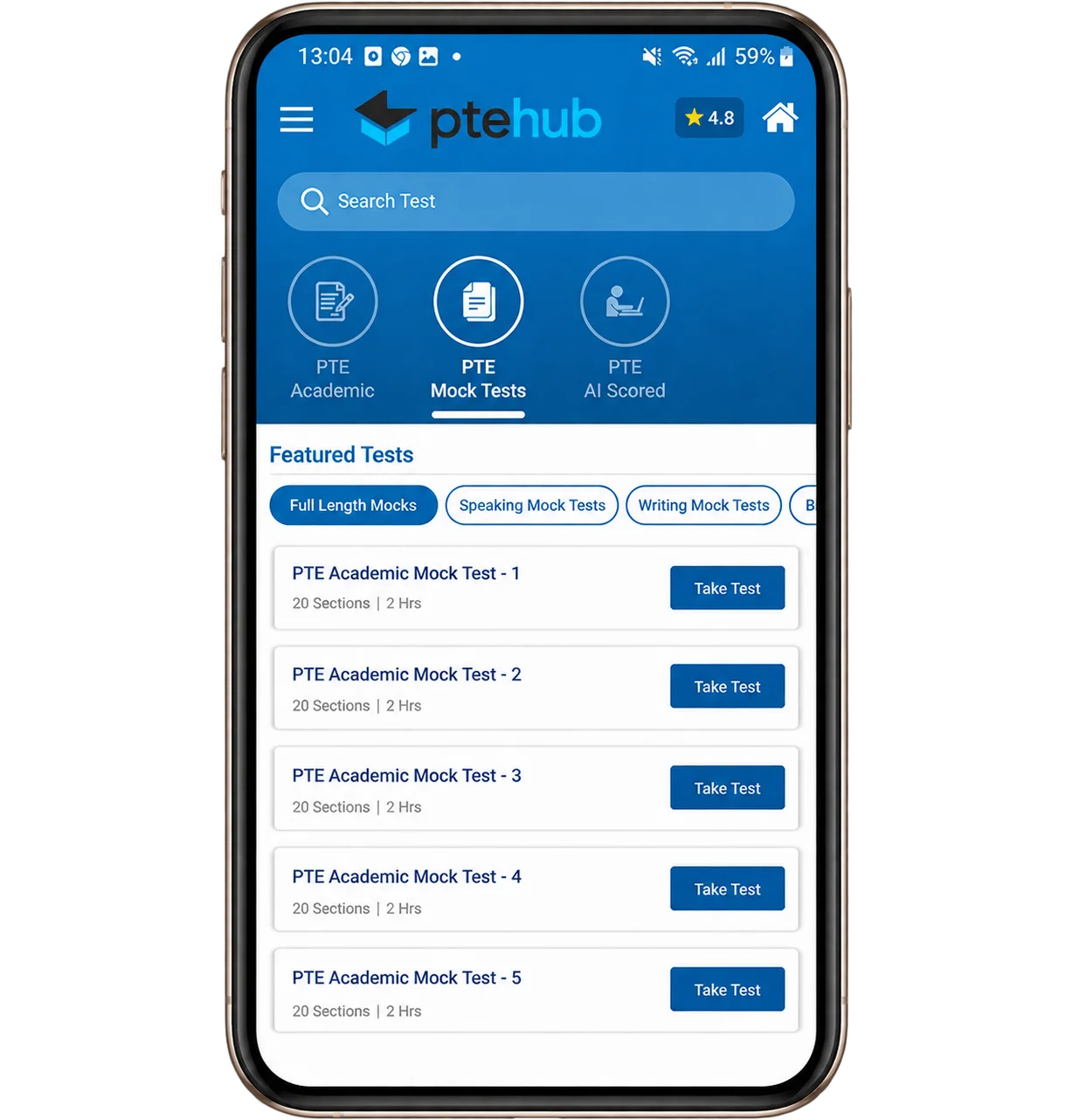

Practice on the PTEHub App

Prepare anywhere, anytime with real exam-like questions, instant AI scoring, and detailed performance insights directly on your mobile device.

PTEHub Mobile App

You May Also Like

Understanding how PTE scoring works can help you prepare more effectively, set realistic score targets, and identify areas that need...
Are you getting a lower PTE Speaking score than expected, even after hours of practice? You may be speaking too...
PTE Describe Image is an important task in the PTE Academic Speaking section. It tests your ability to understand visual...
  If your PTE Speaking score is not improving despite regular practice, you might be wondering what you are doing...

Tags:

Share:

Leave A Reply

Your email address will not be published. Required fields are marked *

PTE Study Plan for 30 Days


Preparing for the PTE Academic exam in 30 days is possible with a structured study plan, consistent practice, and regular performance evaluation. However, simply practising questions every day is not enough. You need to understand the exam format, identify your weaknesses, improve your English skills, and develop strategies for completing each task within the time limit.

A well-organised 30-day PTE study plan helps you divide your preparation into manageable daily tasks while balancing Speaking, Writing, Reading, and Listening. Instead of practising randomly, you can focus on specific skills each week, track your progress, and adjust your preparation according to your mock test results.

Whether you are preparing for your first PTE Academic exam or trying to improve your previous score, this one-month plan will help you build a consistent practice routine.


Can You Prepare for PTE in 30 Days?

Yes, you can make meaningful progress in 30 days if you follow a focused preparation routine. However, your results will depend on your current English proficiency, familiarity with the PTE test format, target score, and the amount of time you can dedicate to practice each day.

Students who already have a strong English foundation may use 30 days to improve task strategies, accuracy, fluency, and time management. Students who are less confident in English may need to spend more time strengthening vocabulary, grammar, pronunciation, listening comprehension, and reading skills.

The goal of a 30-day preparation plan is not simply to complete practice questions. It is to improve your performance through consistent practice, feedback, and targeted revision.

How Many Hours Should You Study for PTE Every Day?

Your daily study time should depend on your current level and target score. Studying for two focused hours is generally more useful than spending four hours practising without reviewing mistakes.

Current English Level Recommended Daily Study Time
Strong English foundation 1.5–2 hours
Intermediate English level 2–3 hours
Weak English foundation 3–4 hours

If you have limited time, follow a shorter study schedule but make sure you practise all four skills regularly. Avoid spending your entire preparation time on only Speaking or Reading because PTE Academic assesses multiple skills through individual and integrated tasks.

Before Starting Your 30-Day PTE Study Plan

Before following the daily schedule, complete these three steps to make your preparation more effective.

1. Take a Diagnostic Mock Test

Start with a full-length PTE mock test to understand your current performance. Do not worry if your initial score is lower than your target.

Use the test to identify:

  • Your current overall score
  • Your Speaking, Writing, Reading, and Listening performance
  • Tasks where you lose marks frequently
  • Time-management problems
  • Pronunciation, grammar, spelling, or comprehension weaknesses

2. Set a Realistic Target Score

Your target score should reflect the requirements of your university, visa pathway, professional registration, or other purpose.

For example, your preparation strategy may differ depending on whether you are aiming for 50–65, 65–79, or 79+.

Do not focus only on achieving a high overall score. If your application requires a minimum score in each communicative skill, make sure your preparation addresses those individual requirements.

3. Prepare a Daily Study Routine

Divide your study time between the four skills and include time for reviewing mistakes.

Your daily preparation should ideally include:

  • Speaking practice
  • Writing practice
  • Reading practice
  • Listening practice
  • Reviewing mistakes and tracking progress

30 Day PTE Study Plan: Daily Schedule

This 30-day PTE preparation plan is divided into four weeks. Each week has a specific objective to help you gradually improve your accuracy, confidence, and exam readiness.

Week 1: Understand the PTE Format and Build Your Foundation

Goal: Familiarise yourself with PTE tasks, identify weaknesses, and establish a consistent practice routine.

Day Focus Daily Practice
Day 1 Diagnostic test Take a full mock test. Review your score and identify your weakest skills and task types.
Day 2 Speaking Practise 10 Read Aloud and 15 Repeat Sentence questions. Focus on pronunciation, fluency, and accurate repetition.
Day 3 Writing Complete 2 Summarize Written Text tasks and 1 Essay. Review grammar, vocabulary, sentence structure, and organisation.
Day 4 Reading Practise 15 Reading and Writing Fill in the Blanks questions and 5 Re-order Paragraphs questions.
Day 5 Listening Practise Summarize Spoken Text, Listening Fill in the Blanks, and 10 Write From Dictation questions.
Day 6 Mixed practice Practise different Speaking, Writing, Reading, and Listening tasks. Review your mistakes and difficult questions.
Day 7 Weekly review Review your practice results, revisit difficult tasks, and identify three weaknesses to improve during Week 2.

Day 2: Speaking Practice

Read Aloud and Repeat Sentence are important speaking tasks that require a combination of pronunciation, fluency, listening accuracy, and concentration.

During practice:

  • Maintain a natural speaking pace.
  • Avoid unnecessary pauses.
  • Pronounce words clearly.
  • Focus on sentence meaning and structure.
  • Record your responses and listen for mistakes.

Use the PTE Speaking practice resources for additional practice with speaking tasks and improving your performance.

Day 3: Writing Practice

Writing practice should focus on understanding the task requirements, writing grammatically correct sentences, and organising information clearly.

For Summarize Written Text, practise identifying the main idea and writing a concise summary. For Essay writing, focus on developing a clear position, supporting your ideas, and maintaining logical paragraph structure.

Explore the PTE Writing practice resources to practise different writing tasks and strengthen your writing skills.

Day 4: Reading Practice

Reading requires vocabulary knowledge, grammar awareness, comprehension, and the ability to identify relationships between sentences.

Practise:

  • Reading and Writing Fill in the Blanks
  • Re-order Paragraphs
  • Reading Fill in the Blanks
  • Multiple-choice questions

Use the PTE Reading practice resources to improve comprehension, vocabulary, and accuracy.

Day 5: Listening Practice

Listening tasks require you to understand spoken information, identify important details, and accurately record information.

Practise:

  • Summarize Spoken Text
  • Listening Fill in the Blanks
  • Write From Dictation
  • Listening multiple-choice questions

Use the PTE Listening practice resources to improve listening comprehension, note-taking, and spelling accuracy.

Week 2: Improve Accuracy and Develop Task Strategies

Goal: Build stronger task-specific skills and improve accuracy under timed conditions.

Day Focus Daily Practice
Day 8 Speaking Practise 10 Read Aloud and 20 Repeat Sentence questions. Focus on fluency, pronunciation, and sentence accuracy.
Day 9 Speaking Practise 5 Describe Image and 3 Retell Lecture questions. Review response structure and delivery.
Day 10 Writing Complete 2 Summarize Written Text tasks and 1 Essay. Review grammar and organisation.
Day 11 Reading Practise 20 Fill in the Blanks questions and 5 Re-order Paragraphs questions.
Day 12 Listening Practise 2 Summarize Spoken Text tasks, Listening Fill in the Blanks, and 15 Write From Dictation questions.
Day 13 Integrated practice Practise tasks that combine skills. Focus on understanding information and responding accurately.
Day 14 Mock test and review Take a full mock test. Compare your results with Day 1 and identify the tasks requiring additional practice.

During Week 2, start practising under time limits. Your goal is to improve accuracy while becoming more comfortable with the pace of the exam.

Do not rush to complete every question. Review why your answers were incorrect and identify whether the problem was vocabulary, grammar, comprehension, concentration, or task strategy.

Week 3: Strengthen Weak Skills and Improve Timing

Goal: Focus on your weakest tasks, improve consistency, and practise completing questions within the required time.

Day Focus Daily Practice
Day 15 Weakest Speaking task Spend 20–30 minutes practising your weakest speaking task. Record and evaluate your responses.
Day 16 Writing Complete 2 Summarize Written Text tasks and 1 Essay under timed conditions.
Day 17 Reading Complete a timed reading practice session. Review vocabulary, incorrect answers, and difficult passages.
Day 18 Listening Practise 2 Summarize Spoken Text tasks, Listening Fill in the Blanks, and 15 Write From Dictation questions.
Day 19 Speaking and Reading Complete a mixed practice session focusing on fluency, comprehension, and accuracy.
Day 20 Writing and Listening Practise writing and listening tasks under time limits. Focus on spelling, grammar, and note-taking.
Day 21 Mock test and review Take a full mock test. Analyse your score, task performance, and timing. Update your error log.

By the end of Week 3, you should have a clearer understanding of your strengths and weaknesses. Your practice should become more targeted rather than following the same routine every day.

If your Speaking score is improving but Listening remains weak, adjust your daily schedule to give Listening more practice time. The same applies to Reading and Writing.

Week 4: Final Revision and Exam Readiness

Goal: Improve consistency, review mistakes, and prepare for the exam without unnecessary pressure.

Day Focus Daily Practice
Day 22 Speaking refinement Practise difficult speaking tasks. Focus on fluency, pronunciation, and avoiding unnecessary pauses.
Day 23 Writing refinement Practise Summarize Written Text and Essay. Review grammar, spelling, structure, and clarity.
Day 24 Reading revision Practise your weakest reading tasks under timed conditions.
Day 25 Listening revision Practise difficult listening tasks. Focus on keywords, note-taking, and spelling.
Day 26 Full mock test Complete a full-length mock test in exam conditions.
Day 27 Mock test analysis Review the mock test thoroughly. Identify recurring mistakes, weak task types, and timing issues.
Day 28 Targeted practice Practise only the task types that need improvement. Avoid spending unnecessary time on tasks you already perform consistently well.
Day 29 Final revision Review strategies, common mistakes, vocabulary, and your error log. Keep practice moderate.
Day 30 Light practice and readiness Do a short, comfortable practice session. Avoid exhausting yourself with another full mock test. Review your exam checklist and rest.

During the final week, prioritise consistency over learning too many new strategies. Your focus should be on reducing mistakes, maintaining confidence, and performing familiar tasks accurately.

PTE Daily Study Schedule: 1, 2, or 3 Hours

Not everyone can study for three or four hours every day. You can adapt this 30-day PTE study plan according to your schedule.

1-Hour Daily PTE Study Schedule

Skill Time
Speaking 15 minutes
Reading 15 minutes
Listening 15 minutes
Writing 10 minutes
Mistake review 5 minutes
Total 60 minutes

This schedule is suitable for students who have limited time but can practise consistently every day.

2-Hour Daily PTE Study Schedule

Skill Time
Speaking 30 minutes
Reading 25 minutes
Listening 25 minutes
Writing 25 minutes
Mistake review 15 minutes
Total 120 minutes

This is a balanced routine for students preparing for PTE while managing work, university, or other responsibilities.

3-Hour Daily PTE Study Schedule

Skill Time
Speaking 45 minutes
Reading 40 minutes
Listening 40 minutes
Writing 35 minutes
Mistake review 20 minutes
Total 180 minutes

This schedule gives you additional time for task-specific practice, timed exercises, and reviewing mock test performance.

You can change the daily allocation depending on your weaknesses. For example, if you struggle with Listening, dedicate more time to listening tasks while maintaining practice in the other skills.

How to Practise Each PTE Skill During the 30 Days

Following a timetable is useful, but understanding what to practise in each skill is equally important.

1. PTE Speaking Practice

Speaking tasks assess your ability to communicate information clearly, fluently, and accurately. Your practice should include both individual speaking tasks and tasks requiring you to listen and respond.

Focus on:

  • Read Aloud
  • Repeat Sentence
  • Describe Image
  • Retell Lecture
  • Answer Short Question
  • Summarize Group Discussion
  • Respond to a Situation

Daily Speaking Routine

  • Practise 5–10 Read Aloud questions.
  • Practise 10–20 Repeat Sentence questions.
  • Practise 2–5 Describe Image responses.
  • Practise Retell Lecture and other integrated speaking tasks.
  • Record your answers whenever possible.
  • Review pronunciation, pauses, fluency, and missing words.

Do not memorise complete responses for every question. Develop a flexible response approach and focus on delivering relevant information naturally. For additional practice, visit the PTE Speaking practice page.

2. PTE Writing Practice

Writing practice should help you develop clear sentences, accurate grammar, logical organisation, and the ability to respond to task requirements.

Focus on:

  • Summarize Written Text
  • Write Essay

Daily Writing Routine

  • Practise Summarize Written Text regularly.
  • Write essays under timed conditions.
  • Check sentence structure and grammar.
  • Improve vocabulary without using unnecessarily complicated words.
  • Review spelling and punctuation.
  • Avoid writing irrelevant information.

When reviewing your writing, do not focus only on the number of words. Check whether your response communicates the main ideas clearly and follows the task requirements. Use the PTE Writing practice page for more task-specific preparation.

3. PTE Reading Practice

Reading tasks require you to understand written information, identify key ideas, recognise vocabulary in context, and use grammatical knowledge.

Focus on:

  • Reading and Writing Fill in the Blanks
  • Multiple Choice, Multiple Answers
  • Re-order Paragraphs
  • Reading Fill in the Blanks
  • Multiple Choice, Single Answer

Daily Reading Routine

  • Complete 10–20 Fill in the Blanks questions.
  • Practise Re-order Paragraphs.
  • Learn new vocabulary from practice passages.
  • Review incorrect answers.
  • Identify why a word or sentence fits the context.

Instead of memorising isolated vocabulary, learn words in phrases and collocations. This will help you recognise how words are used in sentences. Visit the PTE Reading practice page for additional reading exercises.

4. PTE Listening Practice

Listening requires concentration, accurate comprehension, and the ability to recognise important information while listening to recordings.

Focus on:

  • Summarize Spoken Text
  • Multiple Choice, Multiple Answers
  • Fill in the Blanks
  • Highlight Correct Summary
  • Multiple Choice, Single Answer
  • Select Missing Word
  • Highlight Incorrect Words
  • Write From Dictation

Daily Listening Routine

  • Practise short audio recordings.
  • Take notes on important information.
  • Identify keywords and supporting details.
  • Practise spelling words accurately.
  • Complete Write From Dictation exercises.
  • Review mistakes and replay difficult recordings when practising.

Listening practice should not be limited to understanding the general meaning. You should also practise recognising details, words, phrases, and sentence structure. Use the PTE Listening practice page to improve your listening skills and accuracy.

How to Track Your Progress During the 30-Day PTE Study Plan

Tracking your progress helps you understand whether your preparation is improving your performance. Without reviewing your results, you may repeat the same mistakes throughout the month.

After every mock test or practice session, record:

  • Your overall score
  • Individual skill scores
  • Tasks with the lowest performance
  • Common mistakes
  • Time-management issues
  • Your next practice priority

PTE Study Progress Tracker

Date/Day Task Practised Mistake Identified Next Action
Day 2 Repeat Sentence Missing words Practise short sentences and improve listening accuracy
Day 4 Reading Fill in the Blanks Incorrect collocations Review vocabulary and contextual phrases
Day 5 Write From Dictation Spelling errors Practise sentence dictation and proofreading
Day 9 Describe Image Long pauses Improve response flow and timed practice
Day 14 Mock Test Weak Listening Increase listening practice during Week 3

Use this tracker as an example and update it with your actual mistakes.

How to Analyse a PTE Mock Test

After completing a mock test, do not immediately start another one. Spend time analysing your performance.

Follow these steps:

  1. Review your overall score and individual skill scores.
  2. Identify the tasks where you performed poorly.
  3. Check whether mistakes were caused by grammar, vocabulary, comprehension, pronunciation, spelling, or timing.
  4. Record recurring mistakes in your error log.
  5. Practise the weak task types again.
  6. Recheck your performance after a few days.

A mock test is most useful when it helps you understand what needs improvement. Completing several tests without analysing your mistakes may not lead to meaningful progress.

30-Day PTE Study Plan Based on Your Target Score

Your study strategy should change depending on your current level and target score.

If Your Target Score Is 50-65

Focus on building a strong foundation.

Prioritise:

  • Understanding all PTE task types
  • Improving basic grammar
  • Developing vocabulary
  • Practising pronunciation
  • Improving reading comprehension
  • Understanding spoken English
  • Completing tasks accurately

Avoid rushing into difficult strategies before you understand the task requirements.

If Your Target Score Is 65-79

Focus on accuracy, timing, and consistency.

Prioritise:

  • Timed practice
  • Weak task identification
  • Integrated skill tasks
  • Grammar and vocabulary improvement
  • Better note-taking
  • Regular mock tests
  • Reviewing mistakes

At this level, you should already be familiar with the exam format and use practice to improve areas where you are losing marks.

If Your Target Score Is 79+

Focus on refining your performance and reducing recurring errors.

Prioritise:

  • Consistent fluency
  • Accurate responses
  • Strong comprehension
  • Correct spelling and grammar
  • Efficient time management
  • Integrated tasks
  • Mock test analysis

A higher target score requires consistent performance across the relevant tasks and skills. No particular study schedule can guarantee a score of 79 or above.

Common Mistakes to Avoid During Your 30-Day PTE Preparation

Even with a structured PTE study plan, some preparation habits can slow down your progress.

1. Practising Without Reviewing Mistakes

Completing hundreds of questions does not automatically improve your score. Review incorrect answers to understand why you made the mistake and how to avoid repeating it.

2. Ignoring Weak Skills

Many students spend too much time practising tasks they already perform well. Your preparation should be based on your mock test results and weak areas.

3. Taking Mock Tests Without Analysis

Mock tests are useful for measuring progress, but you need to review them carefully. Identify recurring errors and adjust your practice routine.

4. Memorising Templates Without Understanding the Task

Templates can help organise responses, but relying entirely on memorised content can make your answers unnatural or unsuitable for the question.

5. Ignoring Time Management

Practising without time limits may make you comfortable but does not fully prepare you for the test. Gradually introduce timed practice during your second and third weeks.

6. Changing Strategies Too Frequently

Avoid changing your approach after every practice session. Give a strategy enough time to evaluate whether it works, and change it based on actual performance rather than guesswork.

7. Studying Without Breaks

Long study sessions can reduce concentration. Use short breaks between practice sessions to maintain focus and avoid unnecessary fatigue.

What If You Miss a Day in Your 30-Day PTE Study Plan?

Missing a day does not mean you need to restart your preparation.

If you miss a scheduled session:

  • Do not double your workload the following day.
  • Prioritise your weakest skill.
  • Move the missed task to a lighter practice day if necessary.
  • Continue following the overall weekly structure.
  • Keep mock tests and revision sessions in your plan.

Consistency is more important than completing every task exactly as written. Adapt the schedule to your availability while making sure you continue practising all four skills.

Final 3-Day PTE Revision Checklist

Use the final three days to review your preparation, improve confidence, and avoid unnecessary stress.

Day 27: Mock Test Analysis

  • Review your latest mock test scores.
  • Identify your weakest task types.
  • Review your error log.
  • Check recurring grammar, vocabulary, pronunciation, and spelling mistakes.
  • Decide which tasks need final revision.

Day 28: Targeted Practice

  • Practise your weakest tasks.
  • Review strategies you already understand.
  • Complete a short timed practice session.
  • Avoid trying too many new techniques.

Day 29: Final Revision

  • Review your task strategies.
  • Revisit common mistakes.
  • Practise a few familiar questions.
  • Keep your practice light and focused.

Day 30: Light Practice and Exam Readiness

  • Avoid taking another exhausting full mock test.
  • Complete a short warm-up if needed.
  • Check your exam arrangements and required identification.
  • Stay calm and maintain a routine.

If your actual exam is scheduled after Day 30, use this final day as a light revision day and adjust your rest schedule according to your exam date.

Prepare for PTE With a Structured Practice Routine

A 30-day PTE study plan can help you prepare more systematically, but the effectiveness of your preparation depends on how consistently you practise, review mistakes, and improve your weak areas.

Use this schedule as a starting point and adapt it to your English level, target score, and available study time. Focus on improving accuracy and consistency rather than completing practice questions without feedback.

With structured practice, regular mock tests, and a clear understanding of the PTE format, you can make your preparation more focused and productive.

Ready to start practising? Explore PTE preparation resources, AI-scored mock tests, and skill-based practice to help you prepare for your target score.

Explore PTE courses  |  Start your PTE practice


Frequently Asked Questions About the 30-Day PTE Study Plan

1. Can I prepare for PTE in 30 days?

Yes, you can make significant progress in 30 days with consistent practice. Your results depend on your current English proficiency, target score, study hours, and how effectively you review mistakes.

2. How many hours should I study for PTE every day?

Most students can start with 2–3 focused hours daily, while students with a stronger English foundation may need less. If your English skills need improvement, you may benefit from 3–4 hours of structured practice.

3. Can I score 79 in PTE in 30 days?

It may be possible for candidates who already have a strong English foundation and perform close to their target score. However, achieving 79+ in 30 days is not guaranteed and depends on your starting level, practice quality, and performance across skills.

4. What should I practise first when preparing for PTE?

Start with a diagnostic mock test to identify your strengths and weaknesses. Then, focus on understanding the exam format and prioritising the tasks where you lose the most marks.

5. How many mock tests should I take in 30 days?

You can start with a diagnostic mock test, take additional mock tests at the end of Weeks 2 and 3, and complete another full mock test during Week 4. The exact number should depend on your preparation level and available time, but reviewing each mock is more important than taking too many.

6. Can I follow a 30-day PTE study plan if I only have one hour a day?

Yes. Follow the one-hour timetable and practise all four skills regularly. Focus on completing targeted tasks and reviewing mistakes rather than trying to cover too many questions in a single session.

7. Should I practise all four PTE skills every day?

Ideally, you should maintain regular practice across Speaking, Writing, Reading, and Listening. You can dedicate more time to your weakest skill on certain days, but avoid neglecting the others for an entire week.

8. Why is my PTE score not improving despite daily practice?

Your score may not improve if you repeat the same mistakes, practise without feedback, ignore weak tasks, or use ineffective strategies. Analyse your mock test performance and adjust your study plan according to the errors you identify.

9. What should I do if I miss a day in my PTE preparation schedule?

Continue with the plan rather than restarting. Move important tasks to a lighter day if necessary, prioritise your weak skills, and avoid overloading yourself with extra practice.

10. What should I do on the last day before my PTE exam?

Keep your practice light, review familiar strategies, and avoid taking a full mock test that leaves you mentally exhausted. Check your exam arrangements, rest properly, and prepare to focus during the test.

Tags:

Share:

Leave A Reply

Your email address will not be published. Required fields are marked *