
Common PTE Mock Test Mistakes 

  • September 25, 2026
Common PTE Mock Test Mistakes

Taking a PTE mock test is one of the most useful ways to understand your current preparation level. A mock test can help you become familiar with the exam format, practise time management, identify weak areas, and track your progress.

However, simply taking more mock tests does not automatically lead to a higher PTE score.

Many candidates make the same mistakes during their practice. Some focus only on the overall score, while others take one mock test after another without analysing their errors. Some candidates also treat a mock-test score as an exact prediction of their real PTE result.

The most effective approach is to use every mock test as a learning opportunity.

This guide explains the common PTE mock test mistakes, why they happen, and what you can do to avoid them.

Quick Answer

The most common PTE mock test mistakes include taking tests without analysing results, focusing only on the overall score, ignoring individual question types, repeating the same errors, practising without realistic timing, using unreliable mock tests, and treating a mock score as a guaranteed prediction of the real PTE score.

Why Are PTE Mock Tests Important?

A PTE mock test allows you to practise the exam in a structured environment before test day.

A well-designed mock test can help you:
  • Understand the PTE Academic test format
  • Become familiar with different question types
  • Practise completing tasks within the available time
  • Identify your stronger and weaker skills
  • Understand where you are losing marks
  • Monitor your preparation progress
  • Build familiarity with computer-based testing
  • Practise managing time and concentration

However, a mock test should not be treated as the final goal of your preparation.

The real value comes from what you do after receiving your result.

For example, if you receive a low score in a particular skill, simply taking another mock test may not solve the problem. You need to understand why the score was low and then practise the relevant question types or underlying language skills.

A useful preparation cycle is:

Test → Analyse → Practise → Improve → Retest

This approach makes each mock test part of your preparation strategy rather than simply another score on your dashboard.

12 Common PTE Mock Test Mistakes
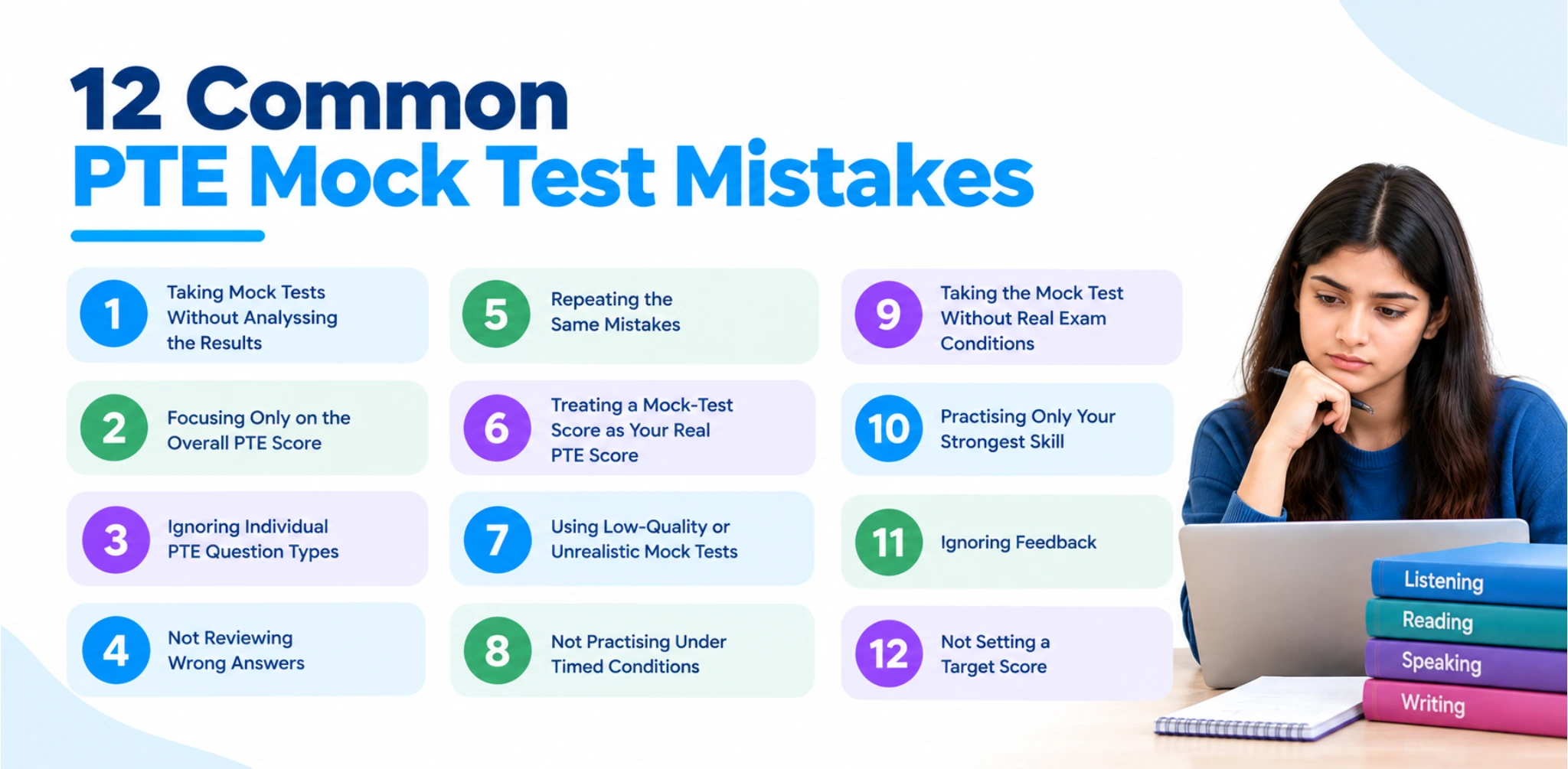
12 Common PTE Mock Test Mistakes

1. Taking Mock Tests Without Analysing the Results

One of the most common PTE mock test mistakes is taking a test, checking the score, and immediately moving on to another test.

For example, a candidate might take three mock tests in one week but never review why particular answers were incorrect.

This can create the impression that they are practising a lot, while the underlying weaknesses remain unchanged.

How to Fix It

After every full mock test, spend time analysing your performance.

Ask yourself:
  • Which skill had the lowest performance?
  • Which question types caused the most difficulty?
  • Did I run out of time?
  • Did I make repeated grammar mistakes?
  • Did I lose concentration during Listening?
  • Did I struggle with pronunciation or fluency?
  • Did I misunderstand particular Reading questions?
  • Did I make avoidable mistakes?

Your goal should not simply be to know what score you received. You should understand why you received that score.

2. Focusing Only on the Overall PTE Score

Another common mistake is looking only at the overall score.

For example, a candidate may receive an overall score they are happy with and assume that their preparation is complete.

However, university or other requirements may include minimum scores for individual skills or specific English-language requirements.

Your overall score therefore should not be the only number you monitor.

How to Fix It

Review your performance across:
  • Speaking
  • Writing
  • Reading
  • Listening

Then go one step further and identify the question types that are affecting your performance.

A candidate with a reasonable overall score may still have a specific weakness that needs attention before the actual test.

3. Ignoring Individual PTE Question Types

PTE Academic contains different task types, and performance can vary considerably between them.

A candidate may perform well in some tasks but repeatedly struggle with others. If you only look at the overall score, you may miss this pattern.

How to Fix It

Create a simple record of your performance.

For example:
Question Type Performance Main Problem
Read Aloud Good Minor fluency issues
Repeat Sentence Weak Difficulty remembering phrases
Describe Image Good Some hesitation
Reading Fill in the Blanks Weak Vocabulary and context
Listening Fill in the Blanks Average Spelling errors

This makes your preparation more specific.

Instead of saying “My PTE score is low,” you can identify the actual problem:

“My Listening Fill in the Blanks performance is weak because I frequently miss words and make spelling errors.”

That is much easier to work on.

4. Not Reviewing Wrong Answers

Getting an answer wrong is not necessarily a problem during practice.

Failing to understand why you got it wrong is a bigger problem.

Some candidates simply check the correct answer and move on.

How to Fix It

For every serious mistake, ask:
  1. What was the correct answer?
  2. Why was my answer wrong?
  3. Did I misunderstand the question?
  4. Did I lack vocabulary?
  5. Did grammar cause the mistake?
  6. Did I make a spelling error?
  7. Did I run out of time?
  8. Was it a concentration problem?
  9. Have I made the same mistake before?

This process turns an incorrect answer into a learning opportunity.

5. Repeating the Same Mistakes

A candidate may notice a mistake but continue making it in future mock tests.

For example, a candidate may repeatedly lose marks because of spelling errors in Listening or hesitation during Speaking.

If the same problem appears repeatedly, it should become a specific preparation priority.

How to Fix It

Maintain a PTE mistake log.

Your mistake log can include:
  • Question type
  • Mistake
  • Reason for mistake
  • Correct approach
  • Practice completed
  • Result after practice

Review the log regularly.

If the same mistake appears several times, do not simply take another full mock test. Spend focused practice time on that weakness.

6. Treating a Mock-Test Score as Your Real PTE Score

A mock test can provide useful information about your preparation, but it should not automatically be treated as an exact prediction of your real PTE score.

Different platforms can use different questions, scoring approaches, evaluation systems, and difficulty levels.

Your actual test performance can also be affected by factors such as:

  • Preparation
  • Question difficulty
  • Test-day conditions
  • Time management
  • Concentration
  • Familiarity with the test environment
  • Performance across different question types

How to Fix It

Use mock-test scores primarily to:

  • Track progress
  • Identify weaknesses
  • Compare performance over time
  • Practise under timed conditions
  • Decide what to study next

A mock test should help answer:

“What should I improve next?”

rather than:

“What exact score will I receive on test day?”

7. Using Low-Quality or Unrealistic Mock Tests

Not every online PTE mock test provides the same preparation experience.

A poor-quality practice test may not accurately reflect the current test structure, question types, timing, or difficulty.

This can make it difficult to understand your actual preparation level.

How to Fix It

When choosing a PTE mock test, look for resources that:

  • Reflect the current PTE Academic format
  • Include relevant question types
  • Provide realistic timing
  • Offer useful feedback
  • Allow you to identify weak areas
  • Help you track progress

You should also use reliable PTE preparation resources alongside mock tests rather than depending on one source alone.

8. Not Practising Under Timed Conditions

Knowing the correct answer is not enough.

PTE Academic is a timed computer-based test, so candidates need to manage both accuracy and time.

Some students perform well when practising individual questions without a time limit but struggle when completing a full test.

How to Fix It

During full mock tests:

  • Follow the allocated time
  • Avoid unnecessary pauses
  • Do not repeatedly restart sections
  • Keep moving through the test
  • Practise maintaining concentration
  • Treat the session like an actual examination

The closer your practice conditions are to the real test environment, the more useful the simulation can be.

9. Taking the Mock Test Without Real Exam Conditions

A mock test is less useful as an exam simulation if you frequently stop, use your phone, check answers online, or receive help from someone else.

These interruptions can make the score difficult to interpret.

How to Fix It

For a full mock test:

  • Choose a quiet environment
  • Put your phone away
  • Avoid outside assistance
  • Use the required equipment
  • Follow the test timing
  • Complete the test from beginning to end

You can practise individual questions casually at other times, but full mock tests should be treated more seriously when your goal is to measure progress.

10. Practising Only Your Strongest Skill

It is natural to enjoy practising areas where you already perform well.

However, spending most of your preparation time on your strongest skill may not solve the weaknesses that are limiting your progress.

For example, if your Speaking performance is strong but Reading is consistently weak, repeatedly practising Speaking may provide less benefit than targeted Reading practice.

How to Fix It

Divide your preparation time according to your needs.

You can use your mock-test results to identify:

  • Strong skills
  • Weak skills
  • Weak question types
  • Repeated mistakes
  • Areas that require more practice

Your strongest skill still needs maintenance, but your weakest areas often deserve more targeted attention.

11. Ignoring Feedback

A score without useful feedback gives you limited information.

Feedback can help you understand areas that require improvement.

Depending on the task and evaluation system, useful feedback may relate to areas such as:

  • Fluency
  • Pronunciation
  • Grammar
  • Vocabulary
  • Content
  • Reading accuracy
  • Listening accuracy
  • Writing organisation

How to Fix It

Do not simply record your score.

Read the available feedback and turn it into an action plan.

For example:

Problem: Frequent hesitation in Speaking

Action: Practise speaking responses with a consistent pace and record your responses for review.

Problem: Repeated spelling errors in Listening

Action: Create a vocabulary and spelling list and practise listening dictation.

The important step is converting feedback into practice.

12. Not Setting a Target Score

Taking a mock test without knowing your target can make it difficult to judge your progress.

Your required score may depend on your specific purpose, such as:

  • University admission
  • Course admission
  • Visa requirements
  • Professional purposes
  • Migration-related requirements

How to Fix It

First, identify the score requirement relevant to your situation.

Then compare your mock-test performance with that requirement.

For example, if your target requires a minimum in each skill, don’t focus only on the overall score.

Your preparation should reflect the actual requirements you need to meet.

PTE Mock Test Mistakes and How to Fix Them

Mistake Why It Is a Problem What to Do Instead
Taking tests without analysis Weaknesses remain unchanged Analyse every result
Focusing only on overall score Individual weaknesses may be hidden Review each skill and task
Ignoring question types Specific problems remain unidentified Track task-level performance
Not reviewing wrong answers You may repeat the same error Understand the reason behind each mistake
Repeating mistakes Practice becomes repetitive Keep a mistake log
Treating mock score as exact Mock scores are not guarantees Use scores to track progress
Using poor-quality tests Practice may not reflect the current exam Use realistic, relevant resources
Ignoring time limits Real test pressure can become difficult Practise under timed conditions
Practising only strong skills Weak areas may continue limiting progress Prioritise weaker areas
Ignoring feedback You lose useful information Turn feedback into targeted practice

How to Analyse Your PTE Mock Test Results

Knowing how to analyse a PTE mock test is just as important as taking one.

Use the following process after each full mock test.

Step 1: Record Your Overall Score

Write down your overall result. This gives you a basic reference point for tracking progress.

Step 2: Check Your Communicative Skills

Review your:
  • Speaking
  • Writing
  • Reading
  • Listening

Identify which skill needs the most attention.

Step 3: Identify Weak Question Types

Look beyond the four skills. Determine which question types caused difficulty.

Step 4: Review Your Mistakes

Look for patterns rather than isolated errors.

For example:
  • Repeated spelling mistakes
  • Frequent hesitation
  • Poor time management
  • Vocabulary gaps
  • Difficulty understanding audio
  • Grammar errors
  • Incorrect reading interpretation

Step 5: Create a Targeted Practice Plan

Choose a small number of weaknesses to work on. Avoid trying to fix everything at once.

Step 6: Practise the Weak Areas

Use targeted practice rather than immediately taking another full mock test.

Step 7: Take Another Mock Test

After enough targeted practice, take another mock test.

Step 8: Compare the Results

Compare your new performance with the previous test.

Look for improvement in both scores and recurring mistakes.

PTE Mock Test Score vs Real PTE Score

A PTE mock-test score and a real PTE score should not automatically be treated as identical.

A mock test is a practice assessment designed to help you understand your preparation.

The real PTE test is administered under official testing conditions and uses Pearson’s official scoring and test delivery system.

Mock-test performance can still be valuable because it allows you to monitor your preparation.

Instead of asking:

“Will this mock score be my real score?”

ask:

“What does this mock result tell me about my preparation?”

That change in approach can make your practice much more useful.

How Often Should You Take a PTE Mock Test?

There is no single number of mock tests that every candidate needs.

The right frequency depends on:
  • Your current score
  • Your target score
  • Your preparation time
  • Your test date
  • Your weak areas
  • How much time you need to analyse and practise between tests

Taking a full mock test every day is not necessarily useful if you do not have enough time to analyse the results.

A better approach is to balance full tests with targeted practice.

For example:

Mock test → Analysis → Targeted practice → Review → Mock test

This gives you time to learn from the previous result before measuring your performance again.

What to Do After a Low PTE Mock Test Score

Getting a low mock-test score does not mean that your preparation has failed.

Instead, use the result to identify what needs to change.

Follow these steps:

  1. Review the overall score.
  2. Check each communicative skill.
  3. Identify your weakest skill.
  4. Identify your weakest question types.
  5. Review repeated mistakes.
  6. Check whether time management affected your performance.
  7. Create a targeted practice plan.
  8. Practise the relevant skills and question types.
  9. Take another mock test after targeted preparation.
  10. Compare your new performance with the previous result.

The goal is not to avoid low scores during practice.

The goal is to learn from them before test day.

How to Use PTE Mock Tests Effectively

Before the Mock Test

Before starting:

  • Know your target score
  • Understand the current test format
  • Prepare a quiet environment
  • Set aside enough uninterrupted time
  • Have the required equipment ready
  • Decide what you want to measure

During the Mock Test

During the test:

  • Follow the timing
  • Avoid outside assistance
  • Stay focused
  • Do not repeatedly pause
  • Treat the test as a realistic simulation
  • Note major difficulties mentally for later review

After the Mock Test

After completing the test:

  • Record your score
  • Review each skill
  • Identify weak question types
  • Analyse incorrect answers
  • Review feedback
  • Record repeated mistakes
  • Practise your weaknesses
  • Plan your next mock test

This creates a complete preparation cycle rather than simply collecting scores.

Use PTE Practice Tests as Part of Your Preparation

A mock test should be one part of a broader preparation strategy.

You can use a PTE practice test to become familiar with question types and evaluate your current preparation.

The important point is to use the result to decide what you should practise next.

For example:

Mock test result → Identify weakness → Targeted practice → Reassessment

This is more useful than taking tests repeatedly without changing your preparation strategy.

Practise PTE Online

Online practice can help you build familiarity with the computer-based format and practise around your schedule.

PTEHub provides resources for PTE practice online, allowing candidates to continue practising different areas of the test.

When practising online, focus on:
  • Speaking fluency
  • Writing structure
  • Reading accuracy
  • Listening accuracy
  • Time management
  • Vocabulary
  • Grammar
  • Repeated mistakes

Use your mock-test results to decide which areas deserve the most attention.

Use PTE Mock Tests to Track Progress

A single mock test gives you one snapshot of your performance.

Multiple tests taken over time can help you identify trends.

For example:
Mock Test Overall Result Main Weakness Action
Test 1 55 Reading Practise Reading
Test 2 58 Listening Target Listening
Test 3 62 Speaking Improve fluency
Test 4 65 Writing Review structure

The exact scores are less important than the pattern.

You want to see whether your weaknesses are changing and whether your preparation is addressing them.

Common PTE Mock Test Mistakes to Avoid Before Exam Day

As your test date approaches, avoid making your preparation unnecessarily complicated.

Do not:
  • Take mock tests without reviewing them
  • Change your entire strategy after one poor result
  • Memorise answers without understanding the task
  • Ignore your weakest skill
  • Depend entirely on one mock-test score
  • Use outdated preparation information
  • Stop analysing your mistakes
  • Focus only on your overall score
  • Take full tests without realistic timing

Instead, use your remaining preparation time strategically.

Focus on the areas that consistently affect your performance.

PTE Mock Test Checklist

Before taking a full PTE mock test, ask yourself:

  • Do I know my target score?
  • Am I familiar with the current test format?
  • Am I taking the test under realistic conditions?
  • Do I have enough uninterrupted time?
  • Am I following the time limits?
  • Will I analyse the result afterwards?
  • Will I record my repeated mistakes?
  • Do I know which skills need improvement?
  • Do I have a plan for targeted practice?
  • Am I using a reliable mock-test resource?

If you can answer these questions, your mock test is more likely to become a useful part of your preparation rather than simply another practice score.

Prepare With Reliable PTE Resources

Mock tests work best when they are combined with other preparation resources.

You can explore PTE preparation materials for additional practice and preparation resources.

If you prefer a structured preparation approach, you can also explore the PTE online course and choose resources according to your preparation needs.

The objective should always be the same:

Identify → Practise → Improve → Measure

Conclusion

The most common PTE mock test mistakes are not necessarily caused by a lack of practice.

Many candidates practise frequently but do not use their results effectively.

Taking a mock test without analysing it, focusing only on the overall score, ignoring individual question types, repeating the same mistakes, and treating mock scores as guaranteed real-test results can make preparation less effective.

A better approach is:

Take the test → Analyse your performance → Identify weaknesses → Practise those weaknesses → Take another test → Compare your progress

A PTE mock test is most valuable when it tells you what to improve next.

Instead of trying to take as many mock tests as possible, focus on making each test part of a clear preparation cycle.

Frequently Asked Questions

What are the most common PTE mock test mistakes?

The most common mistakes include taking mock tests without analysing the results, focusing only on the overall score, ignoring individual question types, repeating the same errors, not practising under timed conditions, using unreliable practice tests, and treating a mock score as an exact prediction of the real PTE result.

Why is my PTE mock test score not improving?

Your score may not improve if you keep taking mock tests without addressing the weaknesses identified in previous tests. Review your skill scores, question types, repeated mistakes, and feedback. Then use targeted practice before taking another full mock test.

Should I take a PTE mock test every day?

Not necessarily. Taking a full mock test every day may have limited value if you do not have enough time to analyse your results and practise your weaknesses. A better approach is to balance mock tests with targeted practice and review.

How should I analyse my PTE mock test?

Start with your overall score, then review Speaking, Writing, Reading, and Listening. Identify weak question types, review incorrect answers, look for repeated mistakes, and create a targeted practice plan. After practising, take another mock test and compare your performance.

Does a PTE mock test predict the real PTE score?

A mock test can provide an indication of your practice performance, but it should not be treated as a guaranteed prediction of your real PTE score. Different practice platforms may use different questions and evaluation methods, while real-test performance can also vary.

What should I do after getting a low PTE mock test score?

Do not simply take another mock test immediately. First identify your weakest skill and question types, review your mistakes, check the feedback, and practise the areas that need improvement. Then take another mock test to measure your progress.

How many PTE mock tests should I take before the exam?

There is no universal number that works for every candidate. The appropriate number depends on your current score, target score, preparation time, and test date. Quality of analysis and targeted practice is generally more important than simply increasing the number of tests.

Are online PTE mock tests accurate?

Online PTE mock tests can be useful for practising question types, timing, and test conditions, but their scores should not automatically be considered identical to an official PTE result. Choose practice resources that reflect the current test format and provide useful feedback.

Should I focus on my overall PTE score or individual skills?

You should monitor both. The overall score gives you a general indication of performance, while individual skill and question-type performance can reveal specific weaknesses that need targeted practice.

How can I improve my PTE mock test score?

Analyse your previous results, identify recurring weaknesses, practise the relevant question types, improve the underlying language skills, and then retest. Avoid simply taking more mock tests without changing your preparation based on the results.
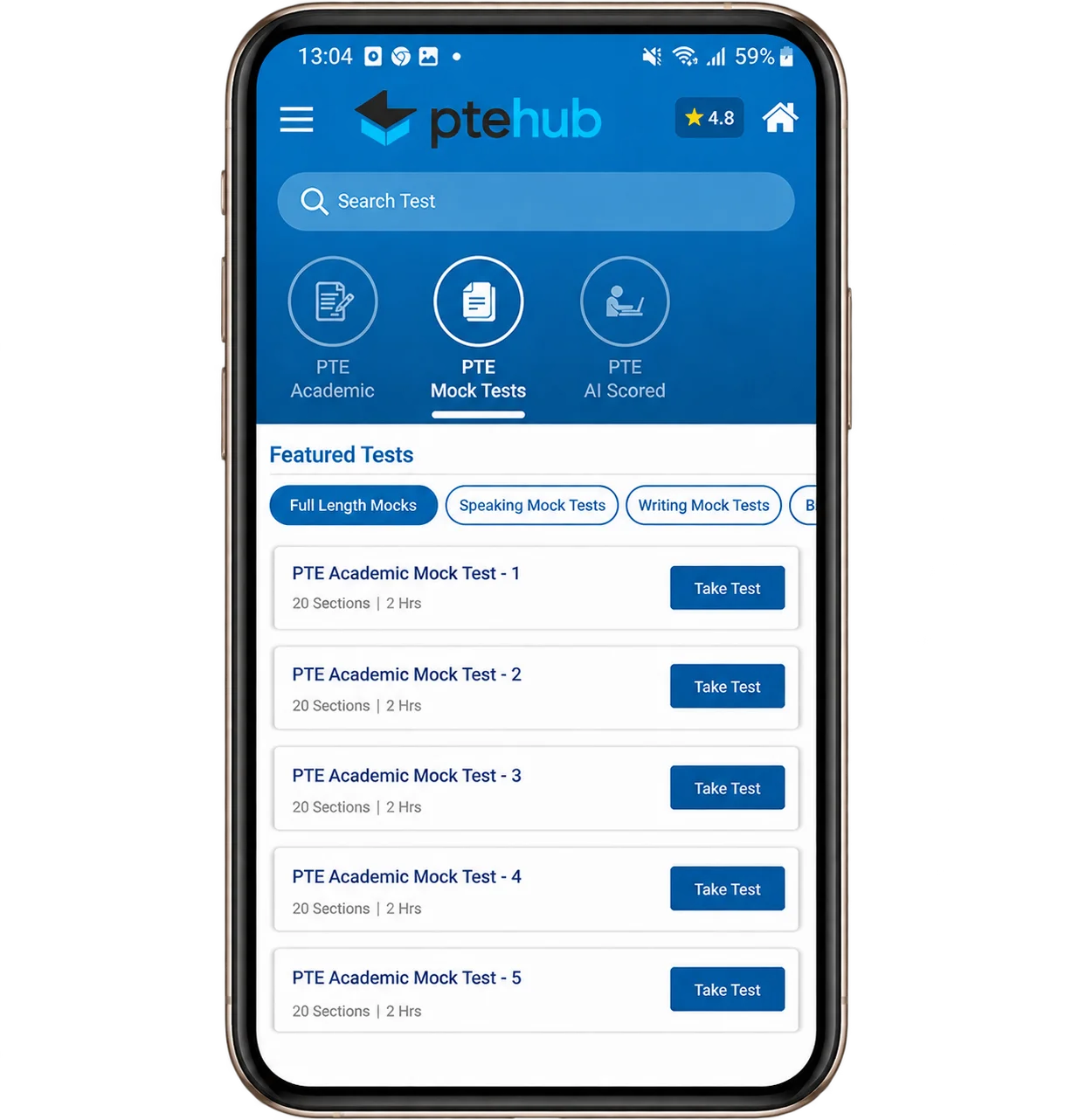

Practice on the PTEHub App

Prepare anywhere, anytime with real exam-like questions, instant AI scoring, and detailed performance insights directly on your mobile device.

PTEHub Mobile App

You May Also Like

Improving your PTE Speaking score is not only about speaking more English. You need to speak clearly, maintain natural fluency,...
PTE Read Aloud practice is one of the most effective ways to improve your pronunciation, oral fluency, and accuracy when...
Preparing for the PTE Academic exam involves more than answering questions repeatedly. Two of the most common preparation methods are...
Planning to study in Australia in 2027 and wondering what PTE score you need? PTE Academic is widely accepted for...

Tags:

Share:

Common PTE Mock Test Mistakes

Taking a PTE mock test is one of the most useful ways to understand your current preparation level. A mock test can help you become familiar with the exam format, practise time management, identify weak areas, and track your progress.

However, simply taking more mock tests does not automatically lead to a higher PTE score.

Many candidates make the same mistakes during their practice. Some focus only on the overall score, while others take one mock test after another without analysing their errors. Some candidates also treat a mock-test score as an exact prediction of their real PTE result.

The most effective approach is to use every mock test as a learning opportunity.

This guide explains the common PTE mock test mistakes, why they happen, and what you can do to avoid them.

Quick Answer

The most common PTE mock test mistakes include taking tests without analysing results, focusing only on the overall score, ignoring individual question types, repeating the same errors, practising without realistic timing, using unreliable mock tests, and treating a mock score as a guaranteed prediction of the real PTE score.

Why Are PTE Mock Tests Important?

A PTE mock test allows you to practise the exam in a structured environment before test day.

A well-designed mock test can help you:
  • Understand the PTE Academic test format
  • Become familiar with different question types
  • Practise completing tasks within the available time
  • Identify your stronger and weaker skills
  • Understand where you are losing marks
  • Monitor your preparation progress
  • Build familiarity with computer-based testing
  • Practise managing time and concentration

However, a mock test should not be treated as the final goal of your preparation.

The real value comes from what you do after receiving your result.

For example, if you receive a low score in a particular skill, simply taking another mock test may not solve the problem. You need to understand why the score was low and then practise the relevant question types or underlying language skills.

A useful preparation cycle is:

Test → Analyse → Practise → Improve → Retest

This approach makes each mock test part of your preparation strategy rather than simply another score on your dashboard.

12 Common PTE Mock Test Mistakes

12 Common PTE Mock Test Mistakes

1. Taking Mock Tests Without Analysing the Results

One of the most common PTE mock test mistakes is taking a test, checking the score, and immediately moving on to another test.

For example, a candidate might take three mock tests in one week but never review why particular answers were incorrect.

This can create the impression that they are practising a lot, while the underlying weaknesses remain unchanged.

How to Fix It

After every full mock test, spend time analysing your performance.

Ask yourself:
  • Which skill had the lowest performance?
  • Which question types caused the most difficulty?
  • Did I run out of time?
  • Did I make repeated grammar mistakes?
  • Did I lose concentration during Listening?
  • Did I struggle with pronunciation or fluency?
  • Did I misunderstand particular Reading questions?
  • Did I make avoidable mistakes?

Your goal should not simply be to know what score you received. You should understand why you received that score.

2. Focusing Only on the Overall PTE Score

Another common mistake is looking only at the overall score.

For example, a candidate may receive an overall score they are happy with and assume that their preparation is complete.

However, university or other requirements may include minimum scores for individual skills or specific English-language requirements.

Your overall score therefore should not be the only number you monitor.

How to Fix It

Review your performance across:
  • Speaking
  • Writing
  • Reading
  • Listening

Then go one step further and identify the question types that are affecting your performance.

A candidate with a reasonable overall score may still have a specific weakness that needs attention before the actual test.

3. Ignoring Individual PTE Question Types

PTE Academic contains different task types, and performance can vary considerably between them.

A candidate may perform well in some tasks but repeatedly struggle with others. If you only look at the overall score, you may miss this pattern.

How to Fix It

Create a simple record of your performance.

For example:
Question Type Performance Main Problem
Read Aloud Good Minor fluency issues
Repeat Sentence Weak Difficulty remembering phrases
Describe Image Good Some hesitation
Reading Fill in the Blanks Weak Vocabulary and context
Listening Fill in the Blanks Average Spelling errors

This makes your preparation more specific.

Instead of saying “My PTE score is low,” you can identify the actual problem:

“My Listening Fill in the Blanks performance is weak because I frequently miss words and make spelling errors.”

That is much easier to work on.

4. Not Reviewing Wrong Answers

Getting an answer wrong is not necessarily a problem during practice.

Failing to understand why you got it wrong is a bigger problem.

Some candidates simply check the correct answer and move on.

How to Fix It

For every serious mistake, ask:
  1. What was the correct answer?
  2. Why was my answer wrong?
  3. Did I misunderstand the question?
  4. Did I lack vocabulary?
  5. Did grammar cause the mistake?
  6. Did I make a spelling error?
  7. Did I run out of time?
  8. Was it a concentration problem?
  9. Have I made the same mistake before?

This process turns an incorrect answer into a learning opportunity.

5. Repeating the Same Mistakes

A candidate may notice a mistake but continue making it in future mock tests.

For example, a candidate may repeatedly lose marks because of spelling errors in Listening or hesitation during Speaking.

If the same problem appears repeatedly, it should become a specific preparation priority.

How to Fix It

Maintain a PTE mistake log.

Your mistake log can include:
  • Question type
  • Mistake
  • Reason for mistake
  • Correct approach
  • Practice completed
  • Result after practice

Review the log regularly.

If the same mistake appears several times, do not simply take another full mock test. Spend focused practice time on that weakness.

6. Treating a Mock-Test Score as Your Real PTE Score

A mock test can provide useful information about your preparation, but it should not automatically be treated as an exact prediction of your real PTE score.

Different platforms can use different questions, scoring approaches, evaluation systems, and difficulty levels.

Your actual test performance can also be affected by factors such as:

  • Preparation
  • Question difficulty
  • Test-day conditions
  • Time management
  • Concentration
  • Familiarity with the test environment
  • Performance across different question types

How to Fix It

Use mock-test scores primarily to:

  • Track progress
  • Identify weaknesses
  • Compare performance over time
  • Practise under timed conditions
  • Decide what to study next

A mock test should help answer:

“What should I improve next?”

rather than:

“What exact score will I receive on test day?”

7. Using Low-Quality or Unrealistic Mock Tests

Not every online PTE mock test provides the same preparation experience.

A poor-quality practice test may not accurately reflect the current test structure, question types, timing, or difficulty.

This can make it difficult to understand your actual preparation level.

How to Fix It

When choosing a PTE mock test, look for resources that:

  • Reflect the current PTE Academic format
  • Include relevant question types
  • Provide realistic timing
  • Offer useful feedback
  • Allow you to identify weak areas
  • Help you track progress

You should also use reliable PTE preparation resources alongside mock tests rather than depending on one source alone.

8. Not Practising Under Timed Conditions

Knowing the correct answer is not enough.

PTE Academic is a timed computer-based test, so candidates need to manage both accuracy and time.

Some students perform well when practising individual questions without a time limit but struggle when completing a full test.

How to Fix It

During full mock tests:

  • Follow the allocated time
  • Avoid unnecessary pauses
  • Do not repeatedly restart sections
  • Keep moving through the test
  • Practise maintaining concentration
  • Treat the session like an actual examination

The closer your practice conditions are to the real test environment, the more useful the simulation can be.

9. Taking the Mock Test Without Real Exam Conditions

A mock test is less useful as an exam simulation if you frequently stop, use your phone, check answers online, or receive help from someone else.

These interruptions can make the score difficult to interpret.

How to Fix It

For a full mock test:

  • Choose a quiet environment
  • Put your phone away
  • Avoid outside assistance
  • Use the required equipment
  • Follow the test timing
  • Complete the test from beginning to end

You can practise individual questions casually at other times, but full mock tests should be treated more seriously when your goal is to measure progress.

10. Practising Only Your Strongest Skill

It is natural to enjoy practising areas where you already perform well.

However, spending most of your preparation time on your strongest skill may not solve the weaknesses that are limiting your progress.

For example, if your Speaking performance is strong but Reading is consistently weak, repeatedly practising Speaking may provide less benefit than targeted Reading practice.

How to Fix It

Divide your preparation time according to your needs.

You can use your mock-test results to identify:

  • Strong skills
  • Weak skills
  • Weak question types
  • Repeated mistakes
  • Areas that require more practice

Your strongest skill still needs maintenance, but your weakest areas often deserve more targeted attention.

11. Ignoring Feedback

A score without useful feedback gives you limited information.

Feedback can help you understand areas that require improvement.

Depending on the task and evaluation system, useful feedback may relate to areas such as:

  • Fluency
  • Pronunciation
  • Grammar
  • Vocabulary
  • Content
  • Reading accuracy
  • Listening accuracy
  • Writing organisation

How to Fix It

Do not simply record your score.

Read the available feedback and turn it into an action plan.

For example:

Problem: Frequent hesitation in Speaking

Action: Practise speaking responses with a consistent pace and record your responses for review.

Problem: Repeated spelling errors in Listening

Action: Create a vocabulary and spelling list and practise listening dictation.

The important step is converting feedback into practice.

12. Not Setting a Target Score

Taking a mock test without knowing your target can make it difficult to judge your progress.

Your required score may depend on your specific purpose, such as:

  • University admission
  • Course admission
  • Visa requirements
  • Professional purposes
  • Migration-related requirements

How to Fix It

First, identify the score requirement relevant to your situation.

Then compare your mock-test performance with that requirement.

For example, if your target requires a minimum in each skill, don’t focus only on the overall score.

Your preparation should reflect the actual requirements you need to meet.

PTE Mock Test Mistakes and How to Fix Them

Mistake Why It Is a Problem What to Do Instead
Taking tests without analysis Weaknesses remain unchanged Analyse every result
Focusing only on overall score Individual weaknesses may be hidden Review each skill and task
Ignoring question types Specific problems remain unidentified Track task-level performance
Not reviewing wrong answers You may repeat the same error Understand the reason behind each mistake
Repeating mistakes Practice becomes repetitive Keep a mistake log
Treating mock score as exact Mock scores are not guarantees Use scores to track progress
Using poor-quality tests Practice may not reflect the current exam Use realistic, relevant resources
Ignoring time limits Real test pressure can become difficult Practise under timed conditions
Practising only strong skills Weak areas may continue limiting progress Prioritise weaker areas
Ignoring feedback You lose useful information Turn feedback into targeted practice

How to Analyse Your PTE Mock Test Results

Knowing how to analyse a PTE mock test is just as important as taking one.

Use the following process after each full mock test.

Step 1: Record Your Overall Score

Write down your overall result. This gives you a basic reference point for tracking progress.

Step 2: Check Your Communicative Skills

Review your:
  • Speaking
  • Writing
  • Reading
  • Listening

Identify which skill needs the most attention.

Step 3: Identify Weak Question Types

Look beyond the four skills. Determine which question types caused difficulty.

Step 4: Review Your Mistakes

Look for patterns rather than isolated errors.

For example:
  • Repeated spelling mistakes
  • Frequent hesitation
  • Poor time management
  • Vocabulary gaps
  • Difficulty understanding audio
  • Grammar errors
  • Incorrect reading interpretation

Step 5: Create a Targeted Practice Plan

Choose a small number of weaknesses to work on. Avoid trying to fix everything at once.

Step 6: Practise the Weak Areas

Use targeted practice rather than immediately taking another full mock test.

Step 7: Take Another Mock Test

After enough targeted practice, take another mock test.

Step 8: Compare the Results

Compare your new performance with the previous test.

Look for improvement in both scores and recurring mistakes.

PTE Mock Test Score vs Real PTE Score

A PTE mock-test score and a real PTE score should not automatically be treated as identical.

A mock test is a practice assessment designed to help you understand your preparation.

The real PTE test is administered under official testing conditions and uses Pearson’s official scoring and test delivery system.

Mock-test performance can still be valuable because it allows you to monitor your preparation.

Instead of asking:

“Will this mock score be my real score?”

ask:

“What does this mock result tell me about my preparation?”

That change in approach can make your practice much more useful.

How Often Should You Take a PTE Mock Test?

There is no single number of mock tests that every candidate needs.

The right frequency depends on:
  • Your current score
  • Your target score
  • Your preparation time
  • Your test date
  • Your weak areas
  • How much time you need to analyse and practise between tests

Taking a full mock test every day is not necessarily useful if you do not have enough time to analyse the results.

A better approach is to balance full tests with targeted practice.

For example:

Mock test → Analysis → Targeted practice → Review → Mock test

This gives you time to learn from the previous result before measuring your performance again.

What to Do After a Low PTE Mock Test Score

Getting a low mock-test score does not mean that your preparation has failed.

Instead, use the result to identify what needs to change.

Follow these steps:

  1. Review the overall score.
  2. Check each communicative skill.
  3. Identify your weakest skill.
  4. Identify your weakest question types.
  5. Review repeated mistakes.
  6. Check whether time management affected your performance.
  7. Create a targeted practice plan.
  8. Practise the relevant skills and question types.
  9. Take another mock test after targeted preparation.
  10. Compare your new performance with the previous result.

The goal is not to avoid low scores during practice.

The goal is to learn from them before test day.

How to Use PTE Mock Tests Effectively

Before the Mock Test

Before starting:

  • Know your target score
  • Understand the current test format
  • Prepare a quiet environment
  • Set aside enough uninterrupted time
  • Have the required equipment ready
  • Decide what you want to measure

During the Mock Test

During the test:

  • Follow the timing
  • Avoid outside assistance
  • Stay focused
  • Do not repeatedly pause
  • Treat the test as a realistic simulation
  • Note major difficulties mentally for later review

After the Mock Test

After completing the test:

  • Record your score
  • Review each skill
  • Identify weak question types
  • Analyse incorrect answers
  • Review feedback
  • Record repeated mistakes
  • Practise your weaknesses
  • Plan your next mock test

This creates a complete preparation cycle rather than simply collecting scores.

Use PTE Practice Tests as Part of Your Preparation

A mock test should be one part of a broader preparation strategy.

You can use a PTE practice test to become familiar with question types and evaluate your current preparation.

The important point is to use the result to decide what you should practise next.

For example:

Mock test result → Identify weakness → Targeted practice → Reassessment

This is more useful than taking tests repeatedly without changing your preparation strategy.

Practise PTE Online

Online practice can help you build familiarity with the computer-based format and practise around your schedule.

PTEHub provides resources for PTE practice online, allowing candidates to continue practising different areas of the test.

When practising online, focus on:
  • Speaking fluency
  • Writing structure
  • Reading accuracy
  • Listening accuracy
  • Time management
  • Vocabulary
  • Grammar
  • Repeated mistakes

Use your mock-test results to decide which areas deserve the most attention.

Use PTE Mock Tests to Track Progress

A single mock test gives you one snapshot of your performance.

Multiple tests taken over time can help you identify trends.

For example:
Mock Test Overall Result Main Weakness Action
Test 1 55 Reading Practise Reading
Test 2 58 Listening Target Listening
Test 3 62 Speaking Improve fluency
Test 4 65 Writing Review structure

The exact scores are less important than the pattern.

You want to see whether your weaknesses are changing and whether your preparation is addressing them.

Common PTE Mock Test Mistakes to Avoid Before Exam Day

As your test date approaches, avoid making your preparation unnecessarily complicated.

Do not:
  • Take mock tests without reviewing them
  • Change your entire strategy after one poor result
  • Memorise answers without understanding the task
  • Ignore your weakest skill
  • Depend entirely on one mock-test score
  • Use outdated preparation information
  • Stop analysing your mistakes
  • Focus only on your overall score
  • Take full tests without realistic timing

Instead, use your remaining preparation time strategically.

Focus on the areas that consistently affect your performance.

PTE Mock Test Checklist

Before taking a full PTE mock test, ask yourself:

  • Do I know my target score?
  • Am I familiar with the current test format?
  • Am I taking the test under realistic conditions?
  • Do I have enough uninterrupted time?
  • Am I following the time limits?
  • Will I analyse the result afterwards?
  • Will I record my repeated mistakes?
  • Do I know which skills need improvement?
  • Do I have a plan for targeted practice?
  • Am I using a reliable mock-test resource?

If you can answer these questions, your mock test is more likely to become a useful part of your preparation rather than simply another practice score.

Prepare With Reliable PTE Resources

Mock tests work best when they are combined with other preparation resources.

You can explore PTE preparation materials for additional practice and preparation resources.

If you prefer a structured preparation approach, you can also explore the PTE online course and choose resources according to your preparation needs.

The objective should always be the same:

Identify → Practise → Improve → Measure

Conclusion

The most common PTE mock test mistakes are not necessarily caused by a lack of practice.

Many candidates practise frequently but do not use their results effectively.

Taking a mock test without analysing it, focusing only on the overall score, ignoring individual question types, repeating the same mistakes, and treating mock scores as guaranteed real-test results can make preparation less effective.

A better approach is:

Take the test → Analyse your performance → Identify weaknesses → Practise those weaknesses → Take another test → Compare your progress

A PTE mock test is most valuable when it tells you what to improve next.

Instead of trying to take as many mock tests as possible, focus on making each test part of a clear preparation cycle.

Frequently Asked Questions

What are the most common PTE mock test mistakes?

The most common mistakes include taking mock tests without analysing the results, focusing only on the overall score, ignoring individual question types, repeating the same errors, not practising under timed conditions, using unreliable practice tests, and treating a mock score as an exact prediction of the real PTE result.

Why is my PTE mock test score not improving?

Your score may not improve if you keep taking mock tests without addressing the weaknesses identified in previous tests. Review your skill scores, question types, repeated mistakes, and feedback. Then use targeted practice before taking another full mock test.

Should I take a PTE mock test every day?

Not necessarily. Taking a full mock test every day may have limited value if you do not have enough time to analyse your results and practise your weaknesses. A better approach is to balance mock tests with targeted practice and review.

How should I analyse my PTE mock test?

Start with your overall score, then review Speaking, Writing, Reading, and Listening. Identify weak question types, review incorrect answers, look for repeated mistakes, and create a targeted practice plan. After practising, take another mock test and compare your performance.

Does a PTE mock test predict the real PTE score?

A mock test can provide an indication of your practice performance, but it should not be treated as a guaranteed prediction of your real PTE score. Different practice platforms may use different questions and evaluation methods, while real-test performance can also vary.

What should I do after getting a low PTE mock test score?

Do not simply take another mock test immediately. First identify your weakest skill and question types, review your mistakes, check the feedback, and practise the areas that need improvement. Then take another mock test to measure your progress.

How many PTE mock tests should I take before the exam?

There is no universal number that works for every candidate. The appropriate number depends on your current score, target score, preparation time, and test date. Quality of analysis and targeted practice is generally more important than simply increasing the number of tests.

Are online PTE mock tests accurate?

Online PTE mock tests can be useful for practising question types, timing, and test conditions, but their scores should not automatically be considered identical to an official PTE result. Choose practice resources that reflect the current test format and provide useful feedback.

Should I focus on my overall PTE score or individual skills?

You should monitor both. The overall score gives you a general indication of performance, while individual skill and question-type performance can reveal specific weaknesses that need targeted practice.

How can I improve my PTE mock test score?

Analyse your previous results, identify recurring weaknesses, practise the relevant question types, improve the underlying language skills, and then retest. Avoid simply taking more mock tests without changing your preparation based on the results.

Tags:

Share:

Leave A Reply

Your email address will not be published. Required fields are marked *