

PTE New Changes 2026: Latest PTE Exam Updates & Format

PTE New Changes 2026: Latest PTE Exam Updates & Format

In the context of PTE Academic Preparation for 2026, it is crucial to study based on the current exam pattern, rather than following the previous patterns for PTE.

Since 7 August 2025, Pearson has made key changes to the PTE Academic and PTE Academic UKVI exams, adding two new Speaking & Writing question types: Summarize Group Discussion and Respond to a Situation. These changes continue to apply to candidates taking the PTE Academic test in 2026.

There are 22 different types of questions in the current PTE format, apart from the two new tasks. Pearson’s present test information also validates that the initial question types have stayed and that there are additional questions in the new format. Average test time is still approximately 2 hours and the PTE score scale is still 10-90.

The Pearson Test of English (PTE) will make significant changes to make the test more realistic to actual communication and introduce a new variant named Express. These reforms are some of the latest PTE reforms in years.

This guide provides information on PTE 2026 updates, the current PTE exam pattern, new question types, PTE score updates, preparation tips, and important things to know before taking the test.

Quick Answer: What Are the Latest PTE Changes in 2026? 

The current PTE Academic format includes the following important changes:

  • Two new question types: Summarize Group Discussion and Respond to a Situation
  • The number of question types increased from 20 to 22
  • The updated test contains more questions than the previous format
  • Both new question types appear in the Speaking & Writing section
  • Some responses now receive additional human expert review of content alongside AI scoring
  • The three main sections remain Speaking & Writing, Reading, and Listening
  • The PTE score remains on a 10–90 scale
  • The average test duration remains around two hours
  • The current format applies to PTE Academic and PTE Academic UKVI
  • The 2025 changes continue to be the current format for candidates taking PTE in 2026.

If you are preparing for PTE Academic in 2026, you should learn the new format (Summarize Group Discussion and Respond to a Situation) and not just the old one.

PTE New Changes 2026 at a Glance

PTE feature  Previous format  Current format in 2026 
Question types  20  22 
New question types  None 2
New Speaking tasks  None Summarize Group Discussion, Respond to a Situation 
Main sections  3 3
Score scale  10–90  10–90 
Average test duration  Around 2 hours  Around 2 hours 
Scoring  AI-based scoring  AI scoring with human expert review for content in selected tasks 

The test format and question types of the current PTE Academic test remain the same with the addition of two new Speaking tasks.

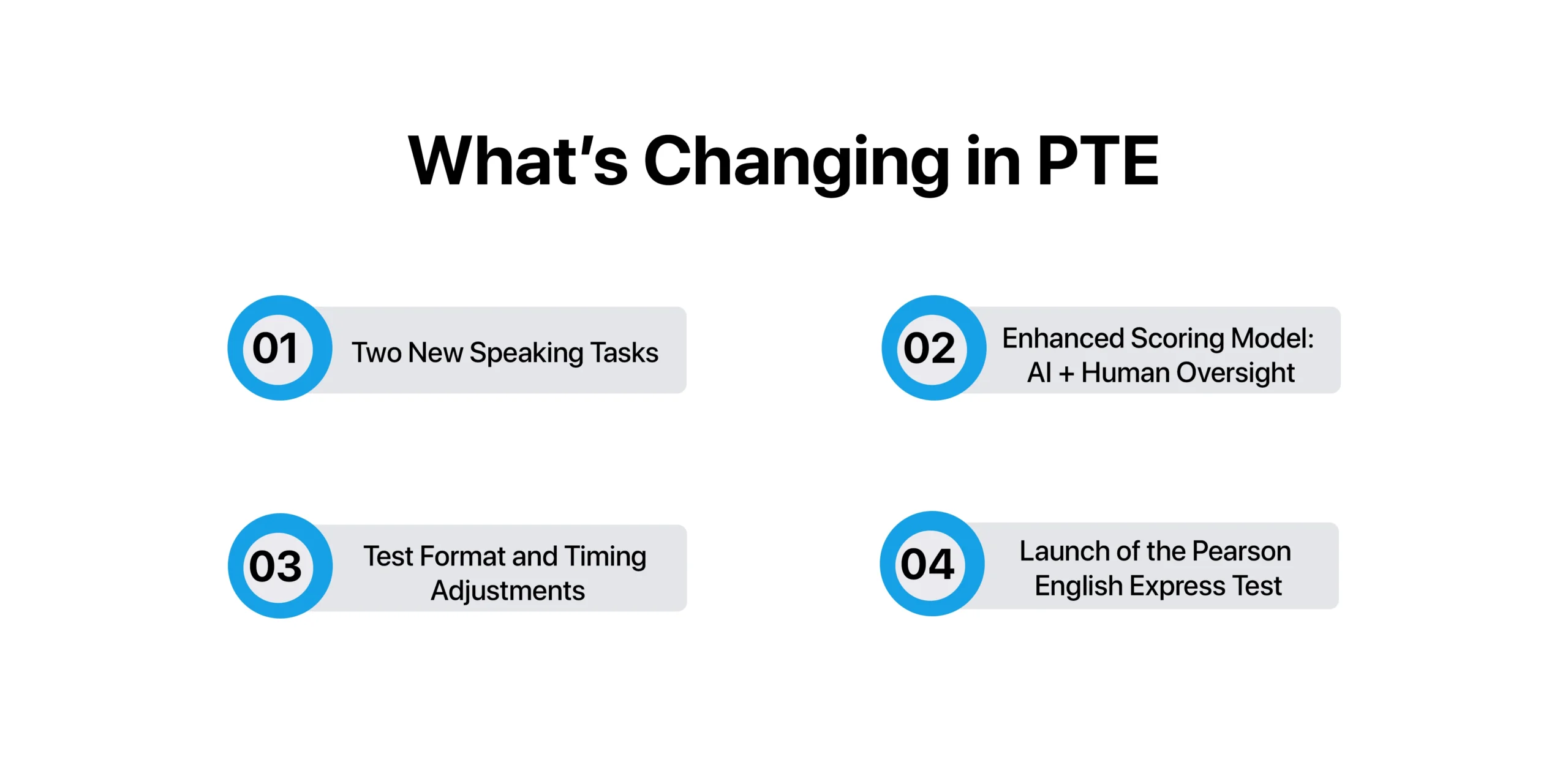
What’s Changing in PTE
What’s Changing in PTE

What Changed in the PTE Exam? 

The most important PTE exam changes are the two new Speaking & Writing question types:

  1. Summarize Group Discussion
  2. Respond to a Situation

The tasks were introduced by Pearson to provide candidates with additional opportunities to communicate in authentic academic and real world contexts.

Now let’s take a closer look at each of the new tasks.

1. Summarize Group Discussion 

Summarize Group Discussion: Speaking task that involves listening to a discussion between 3 people and summarizing the discussion in a different way.

However, the discussion allows for a maximum of three minutes in Pearson’s current PTE format. Once the recording is complete, there will be 10 seconds to prepare and 2 minutes to speak.

Summarize Group Discussion Format 

Feature  Current PTE format 
Number of speakers  3
Topic  Academic discussion 
Skills assessed    Listening and Speaking 
Audio length  Up to 3 minutes 
Preparation time  10 seconds 
Speaking time  2 minutes 
Response  Spoken summary 

You may make written notes on the dry-erase white-board in your room during the conversation. You hear the recorded conversation one time, and after it’s over, you will speak your summary.

What Does Summarize Group Discussion Tests? 

This question type tests your ability to:

  • understand a discussion;
  • identify the main topic;
  • understand different speakers’ viewpoints;
  • connect ideas;
  • distinguish important information from minor details;
  • paraphrase information;
  • speak clearly and fluently.

Pearson scoring information for the response indicated that the answer was marked out for: Content, pronunciation and oral fluency and all scoring inputs (including the human expert review of the Content scores prior to calculation of the score), were taken into consideration.

How to Answer Summarize Group Discussion 

A simple approach is:

Listen → Note → Organize → Summarize

As you are listening, take note of the main point of each speaker’s utterance as opposed to trying to write out every word.

For example:

Topic → Speaker 1 → Speaker 2 → Speaker 3 → Relationships between ideas → Overall conclusion

During your response:

  1. Introducing the main topic.
  2. Explain the first speaker’s main idea.
  3. Explain the other speakers’ viewpoints.
  4. Mention important supporting details.
  5. Show how the speakers’ ideas relate to one another.
  6. Finish with the overall point of the discussion.

Do not simply repeat the recording. Pearson states that the best responses paraphrase the discussion and explain each speaker’s contribution. An irrelevant or unoriginal response can receive no credit. 

2. Respond to a Situation 

Situation is one of the new question types of Speaking in the latest PTE Academic format.

You read and listen to a description of a situation and then give a longer spoken answer to the description, explaining what you would say in the situation you have just heard.

Pearson’s current guidance is that the text prompt is a maximum of 60 words. Once the tape is completed, you will get 10 seconds to prepare and 40 seconds to speak.

Respond to a Situation Format 

Feature  Current PTE format 
Question type  Speaking 
Prompt  Description of a situation 
Text prompt  Up to 60 words 
Preparation time  10 seconds 
Speaking time  40 seconds 

Examples cover realistic university or student/every day situations such as a student going up to ask a lecturer for something else, asking another student if they can help them, solving problems with staff at the university etc.

What Does Respond to a Situation Test? 

This task evaluates whether you can:

  • understand the situation correctly;
  • respond appropriately;
  • address the purpose of the prompt;
  • use suitable formal or informal language;
  • communicate clearly;
  • speak with understandable pronunciation and natural fluency.

The content of the response is important as well. If you misunderstand a major point in the situation you will lose content points for your response.

How to Answer Respond to a Situation ?

Use a flexible structure rather than memorizing one complete response:

Understand → Respond → Explain → Close

For example:

  1. Identify who you are speaking to.
  2. Understand what the situation requires.
  3. Give a direct response.
  4. Explain your reason or request.
  5. Add an appropriate next step or closing statement.

The exact language should change according to the situation.

PTE Exam Pattern 2026: What Is the Current Format? 

The PTE Academic exam continues to have three main parts:

Part 1: Speaking & Writing

This section is the first and longest of the paper. On the existing format page Pearson mentions nine question types included in this section; two of these are new and have been added as a result of the new Speaking tasks. The section lasts about 76-84 minutes.

The current question types are:

  1. Read Aloud
  2. Repeat Sentence
  3. Describe Image
  4. Retell Lecture
  5. Answer Short Question
  6. Summarize Group Discussion
  7. Respond to a Situation
  8. Summarize Written Text
  9. Write Essay

Part 2: Reading 

PTE Academic – Reading The PTE Academic Reading section remains as the second part of the test and consist the already listed PTE exam question types.

Part 3: Listening 

The final section of the test is Reading. The test structure, as in all three parts of the test, is still the same. If you want a broader overview of PTE registration, fees, exam information and preparation, read our PTE exam 2026 guide 

PTE Question Types: Old vs Current Format 

One of the most important things to understand is that Pearson did not replace the original PTE question types.

The original 20 question types remain, and two new question types were added. This increased the total number of question types to 22.

Feature  Previous PTE  Current PTE 
Original question types  20  20 
New question types  0 2
Total question types  20  22 
Summarize Group Discussion  No  Yes
Respond to a Situation  No  Yes
Main sections  3 3
Score scale  10–90  10–90 

This way candidates who used to prepare for PTE would not be required to relearn the entire paper. But they would indeed add 2 question types in their preparations

Has the PTE Scoring System Changed in 2026? 

The PTE scoring scale remains 10–90.

Candidates still receive an overall score as well as scores for the four communicative skills:

  • Listening
  • Reading
  • Speaking
  • Writing

However, Pearson has enhanced the scoring process for the updated test.

All question types are marked by AI; however some question types are also marked for Content by a human expert before the final score is awarded. 

At the present Score Guide, by Pearson, it states that the tasks below would also have human expert marking for Content: Describe Image, Retell Lecture, Respond to a Situation, Summarize group discussion, Summarize written text, Write essay, Summarize spoken text.

Does PTE Still Use AI Scoring? 

Yes, PTE still relies on AI scoring, however human annotators will review parts of specific responses. “The new PTE scoring system is advanced artificial intelligence guided by human insight,” the test developer Pearson stated in a press release, earlier. 

“Human annotators,” Pearson elaborated further, “review specified parts of certain responses when the Pearson scoring process is in need of them. It’s not the same as a person hand-scoring the response,” the statement had read.”

The method in use today involves an integration of AI and human examination where needed.

For candidates, the practical lesson is to focus on:

  • accurate content
  • relevant answers
  • appropriate language
  • clear pronunciation
  • natural oral fluency
  • original responses

Do PTE Templates Still Work in 2026?

Candidates can still use templates to structure their answers but must not give an answer that is entirely memorised. This has been a significant factor with the two new tasks.

For Summarize Group Discussion

And, given that you also need to respond to content from three different Speakers, a memorized or “fixed” response can’t always hit the target for every conversation you’ll find yourself in.

For Respond to a Situation 

This scenario, audience, and purpose all require a tailored answer-not a pre-learned one that might be incorrect in real life.

It’s best to create adaptable frameworks:

For example:

Respond to a Situation

  • acknowledge the situation;
  • answer the request;
  • explain your reason;
  • suggest an action;
  • close naturally.

The structure stays flexible while the actual content changes according to the prompt.

Is PTE Harder in 2026?

If you have previously prepared for the old format, the new format might seem a little different, but Pearson has not stated that PTE will be harder.

Changes are intended to provide candidates with more opportunities to demonstrate the English language in realistic situations. The vast majority of the test doesn’t change, Pearson also says.

The key change for candidates is to be familiar with:

  • Summarize Group Discussion
  • Respond to a Situation
  • updated question distribution
  • current scoring criteria
  • current practice materials

The new tasks become routine once you know the structure of the work.

Has the PTE Test Duration Increased? 

You wouldn’t see much difference for the general average test length. Pearson confirmed that the tests haven’t been lengthened for more than a couple of minutes on average since new questions have been added, and several questions were tweaked regarding the number of certain question items you would see. 

Do not quote incorrect previous information stating the new test format would take an average of 10 – 15 minutes to be completed. Actual length would depend on which particular iteration of the test you are given.

What Has Not Changed in PTE? 

Some of the changes in PTE are major but much more remains consistent.

The three main sections remain

The test still consists of:

  • Speaking & Writing
  • Reading
  • Listening

The 10–90 score scale remains

The PTE Academic score continues to be reported on a 10–90 scale.

The original question types remain

The original 20 question types have not been removed. The two new Speaking tasks have been added to them.

The test remains computer-based

The way candidates take the test has not fundamentally changed as part of these updates. Pearson also states that there were no changes to the booking process or ID requirements as part of the 2025 update.

Fast score delivery remains

Pearson says PTE scores are typically available in two days and no more than five days.

If you are also deciding between different English proficiency tests, see our PTE vs IELTS to compare the two exams. 

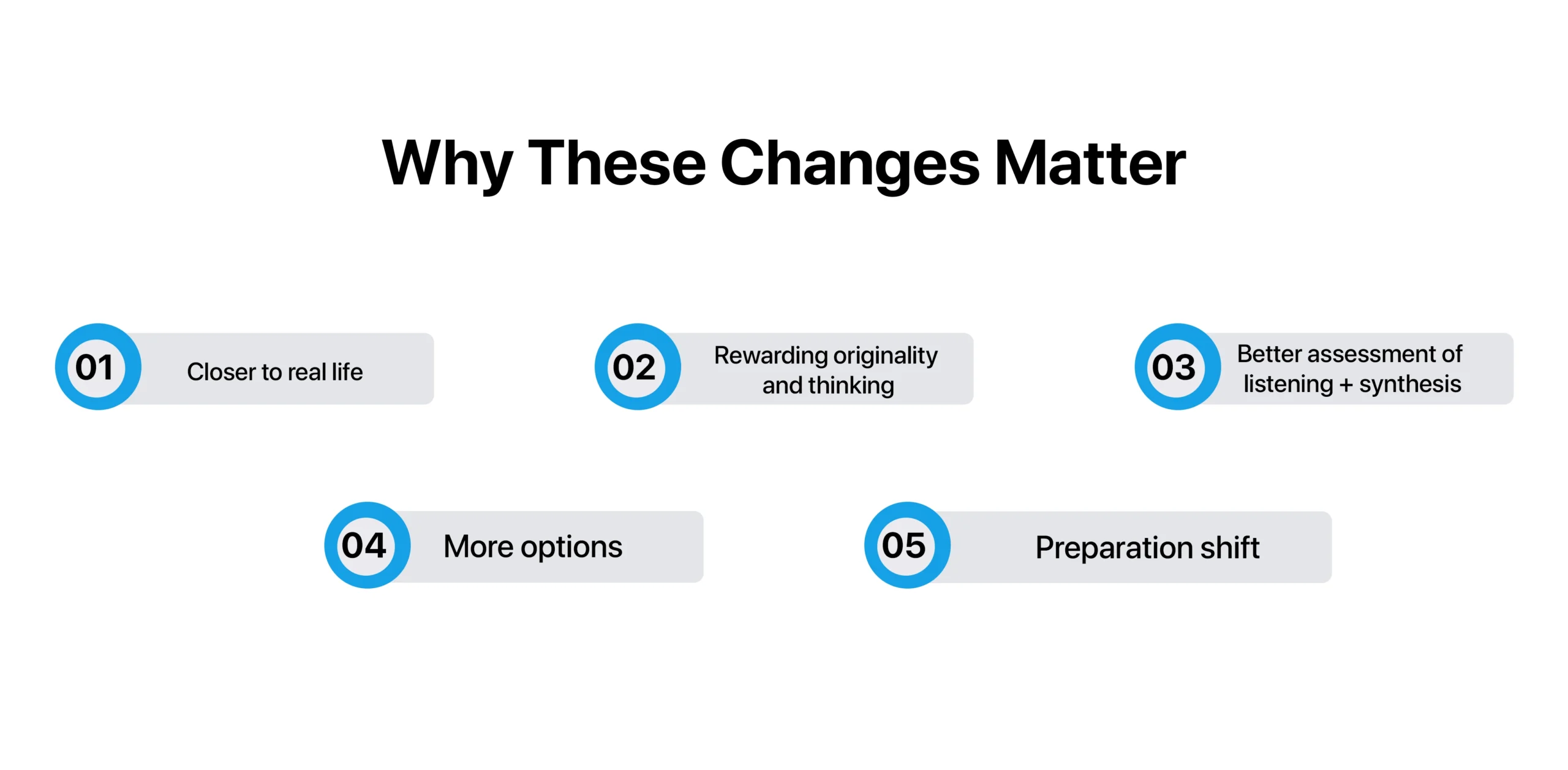
Why These Changes Matter
Why These Changes Matter

1. Closer to real life

The new tasks emphasise real-world skills, such as responding to situations and summarising group conversations, which are everyday academic and workplace tasks.

2. Rewarding originality and thinking

With stronger anti-template detection and human review, candidates who think and speak on the spot (rather than relying on rehearsed scripts) have an advantage.

3. Better assessment of listening + synthesis

Summarise Group Discussion evaluates not just speaking, but also listening comprehension, information filtering, and summarisation skills.

4. More options

The Express test gives flexibility for learners in areas with limited test centre access.

5. Preparation shift

Candidates must now incorporate more spontaneous speaking, critical listening, and summarising skills into their preparation, not just memorising standard responses.

How Should You Prepare for the PTE Exam in 2026? 

If you are taking PTE in 2026, your preparation should use the current PTE format.

For structured preparation, you can explore our PTE preparation packages, which provide different options based on your preparation needs.  

1. Learn the two new question types

Before starting full mock tests, make sure you understand:

  • Summarize Group Discussion
  • Respond to a Situation

Learn the task requirements, timing and scoring criteria.

2. Practise listening and note-taking

Summarize Group Discussion requires you to process information from three speakers.

During the audio, focus on keywords rather than writing complete sentences.

Record:

  • topic;
  • speaker 1’s main idea
  • speaker 2’s main idea
  • speaker 3’s main idea
  • relationships between ideas
  • important supporting details

3. Practise spontaneous speaking

For Respond to a Situation, practise answering unfamiliar scenarios.

Give yourself only 10 seconds to plan and 40 seconds to respond so that your practice matches the real task.

4. Use current-format practice tests

Do not rely exclusively on mock tests created before the current PTE format was introduced.

Full-length practice is also important for becoming familiar with the updated exam format. Our Standard Mock Test Bundle can be used to practise under timed, exam-style conditions. 

5. Review your mistakes

After each practice test, identify:

  • weak question types;
  • timing problems;
  • pronunciation issues;
  • fluency problems;
  • listening errors;
  • vocabulary gaps;
  • content mistakes.

The purpose of a mock test is not simply to receive a score. It should show you what to improve.

6. Build a realistic study schedule

A balanced preparation plan should include all four skills.

For example:

Daily

  • Speaking practice
  • Listening practice
  • Reading practice
  • Writing practice

Weekly

  • Full mock test
  • Error analysis
  • Review of weak question types

If you are preparing from home, our PTE practice at home guide can help you organize your preparation.

How to Prepare for Summarize Group Discussion 

Because Summarize Group Discussion is one of the most important new PTE changes, it deserves dedicated practice.

Step 1: Identify the topic

As soon as the discussion begins, determine what the speakers are discussing.

Step 2: Listen for each speaker’s contribution

Do not focus only on the first speaker.

You need to understand the contributions of all three speakers.

Step 3: Take short notes

Use keywords and abbreviations.

For example:

Topic: online learning

S1: flexibility
S2: interaction issue
S3: technology benefits

Step 4: Identify relationships

Listen for:

  • agreement;
  • disagreement;
  • examples;
  • explanations;
  • Contrasting opinions.

Step 5: Organize your response

Start with the main topic and then explain the key contributions.

Step 6: Paraphrase

Do not simply repeat the recording word-for-word.

Pearson specifically states that the best responses paraphrase the discussion, expand on the speakers’ contributions and connect ideas.

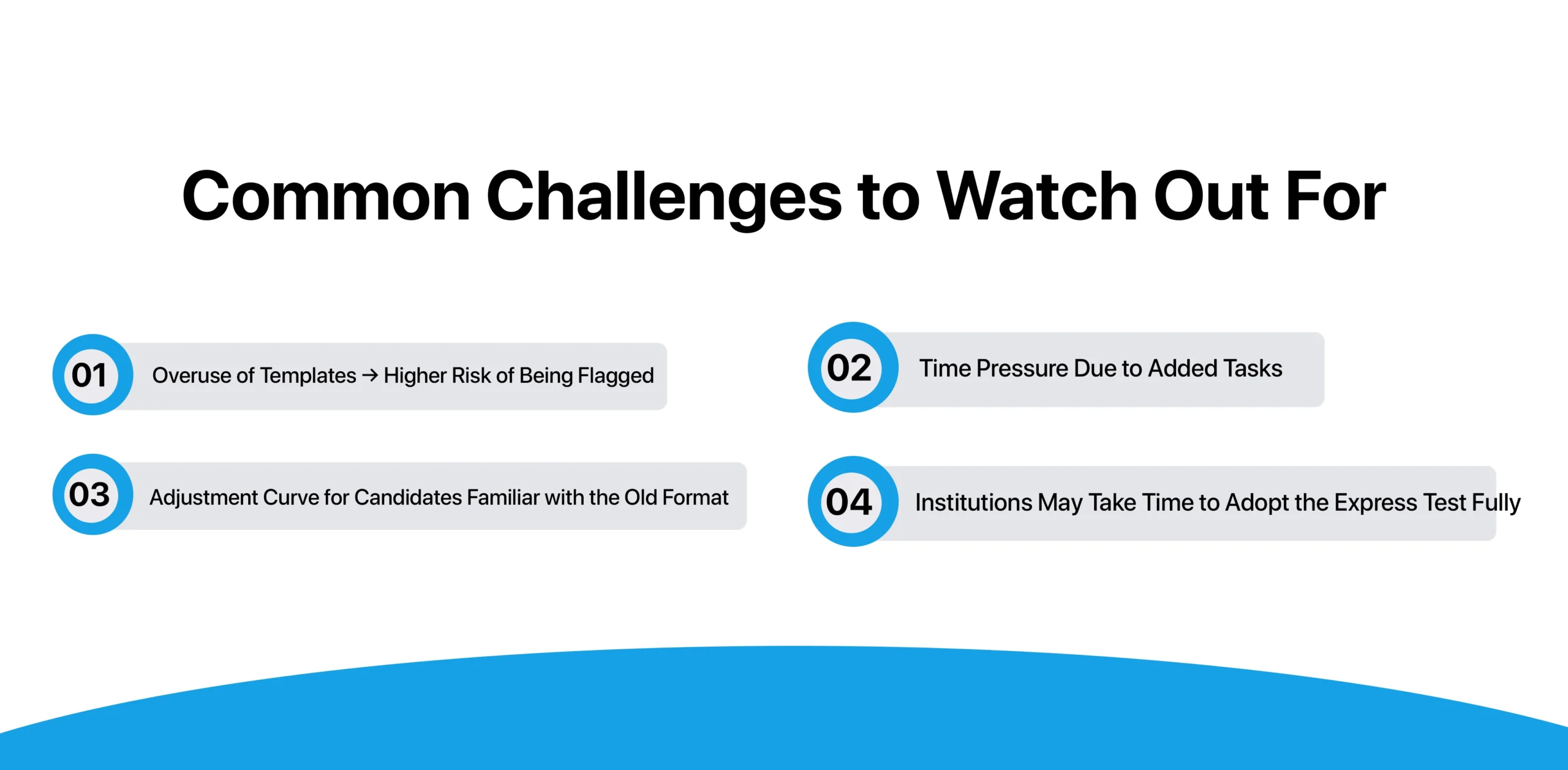
Common Mistakes Candidates Make With the New PTE Format
Common Challenges to Watch Out For

1. Using outdated PTE preparation materials

Old materials may not contain the two new question types. Always check whether your mock tests reflect the current format.

To practise the current format, use updated mock tests that include the latest PTE question types. The Premium Mock Test Bundle can be used for additional full-length practice. 

2. Memorizing complete answers

Memorized responses may fail to address the specific task.

Use flexible structures instead.

3. Ignoring Listening practice

Summarize Group Discussion directly combines Listening and Speaking.

Strong listening skills are therefore essential.

4. Misunderstanding the situation

In Respond to a Situation, you need to respond to the exact scenario.

Missing an important detail can hurt your Content score.

5. Trying to speak too quickly

You do not need to rush.

Pearson advises candidates to speak clearly and use the available response time effectively.

6. Practising only individual questions

While it is useful to practice individual questions, it does not prepare you for the full PTE exam experience. The full-length tests will teach you how to focus, pace yourself and develop the endurance to finish the exam. 

To become familiar with the full test experience, you can use the PTE Standard Mock Test Bundle for repeated exam-style practice.

Conclusion

The new PTE format for 2026 involves two added tasks: Summarize Group Discussion and Respond to a Situation. Unlike in previous formats, candidates need to apply themselves-don’t just rely on your memorised english! The tasks require you to interpret, structure and respond to information naturally and articulately.

However, in good news to those preparing PTE, most of the structure is still the same: Speaking, Writing, Reading and Listening make up the four sections, there is still a score range of 10-90 and the average time it takes to complete the test is around two hours.

If you are going to be completing PTE in 2026, make sure that your PTE practice materials are up-to-date! Begin by practicing PTE at home, and then consider using a PTE mock test and PTE practice course, in order to complete the PTE test under timed conditions. 

The strategy is very simple: know the new 2026 PTE format and new PTE question types and ensure you respond relevantly and naturally rather than by learning the whole answer word-for-word.

FAQs

What are the latest PTE changes in 2026? 

In the current format of the PTE Academic, there are two new Speaking question types: Summarize Group Discussion and Respond to a Situation. The number of types of questions grew from 20 to 22, but the three-section structure and 10-90 scoring scale are maintained.

When did the new PTE changes start? 

The following updates are for the current versions of PTE Academic and PTE Academic UKVI, which is for tests taken from 7 August 2025 onwards. Therefore, the aspirants who are appearing for the PTE Exam in 2026 should prepare for this new version.

What are the two new PTE question types? 

The two new PTE Academic question types are:

  1. Summarize Group Discussion
  2. Respond to a Situation

Both are included in the Speaking & Writing section.

What is Summarised Group Discussion in PTE? 

It is a Speaking task where you listen to a conversation between three people and you have to put together the conversation in your own words. You have 10 seconds to get ready and 2 minutes to talk. 

What is Respond to a Situation in PTE? 

This is a Speaking task in which you read and listen to a description of a situation and give an extended spoken response. You will have 10 seconds to prepare and 40 seconds to speak. 

How many question types are in the current PTE exam? 

There are 22 question types in the current PTE Academic format. The original 20 question types are still there, and the two new Speaking tasks have been added.

Does PTE still use AI scoring? 

Yes. PTE continues to use AI scoring, with human expert review of Content for selected question types before the final score is confirmed. 

Does PTE still have a score out of 90? 

Yes. The PTE Academic score remains on a 10–90 scale. 

How long is the current PTE exam? 

The average PTE Academic test duration remains around two hours.
Practice on the PTEHub App

Prepare anywhere, anytime with real exam-like questions, instant AI scoring, and detailed performance insights directly on your mobile device.

PTEHub Mobile App

You May Also Like

Getting ready for PTE isn’t just about accumulating practice questions. The best resources for preparing for PTE will equip you...
PTE Academic study means practicing and repeating individual questions as many times as you can, it also means gaining an...
There are several regulatory thresholds to pass in order to navigate the global higher education, international employment and migration systems....
With the demand for international education and career prospects available in the world increasing, Pearson Test of English (PTE) remains...

Share:

PTE New Changes 2026: Latest PTE Exam Updates & Format

In the context of PTE Academic Preparation for 2026, it is crucial to study based on the current exam pattern, rather than following the previous patterns for PTE.

Since 7 August 2025, Pearson has made key changes to the PTE Academic and PTE Academic UKVI exams, adding two new Speaking & Writing question types: Summarize Group Discussion and Respond to a Situation. These changes continue to apply to candidates taking the PTE Academic test in 2026.

There are 22 different types of questions in the current PTE format, apart from the two new tasks. Pearson’s present test information also validates that the initial question types have stayed and that there are additional questions in the new format. Average test time is still approximately 2 hours and the PTE score scale is still 10-90.

The Pearson Test of English (PTE) will make significant changes to make the test more realistic to actual communication and introduce a new variant named Express. These reforms are some of the latest PTE reforms in years.

This guide provides information on PTE 2026 updates, the current PTE exam pattern, new question types, PTE score updates, preparation tips, and important things to know before taking the test.

Quick Answer: What Are the Latest PTE Changes in 2026? 

The current PTE Academic format includes the following important changes:

  • Two new question types: Summarize Group Discussion and Respond to a Situation
  • The number of question types increased from 20 to 22
  • The updated test contains more questions than the previous format
  • Both new question types appear in the Speaking & Writing section
  • Some responses now receive additional human expert review of content alongside AI scoring
  • The three main sections remain Speaking & Writing, Reading, and Listening
  • The PTE score remains on a 10–90 scale
  • The average test duration remains around two hours
  • The current format applies to PTE Academic and PTE Academic UKVI
  • The 2025 changes continue to be the current format for candidates taking PTE in 2026.

If you are preparing for PTE Academic in 2026, you should learn the new format (Summarize Group Discussion and Respond to a Situation) and not just the old one.

PTE New Changes 2026 at a Glance

PTE feature  Previous format  Current format in 2026 
Question types  20  22 
New question types  None 2
New Speaking tasks  None Summarize Group Discussion, Respond to a Situation 
Main sections  3 3
Score scale  10–90  10–90 
Average test duration  Around 2 hours  Around 2 hours 
Scoring  AI-based scoring  AI scoring with human expert review for content in selected tasks 

The test format and question types of the current PTE Academic test remain the same with the addition of two new Speaking tasks.

What’s Changing in PTE

What’s Changing in PTE

What Changed in the PTE Exam? 

The most important PTE exam changes are the two new Speaking & Writing question types:

  1. Summarize Group Discussion
  2. Respond to a Situation

The tasks were introduced by Pearson to provide candidates with additional opportunities to communicate in authentic academic and real world contexts.

Now let’s take a closer look at each of the new tasks.

1. Summarize Group Discussion 

Summarize Group Discussion: Speaking task that involves listening to a discussion between 3 people and summarizing the discussion in a different way.

However, the discussion allows for a maximum of three minutes in Pearson’s current PTE format. Once the recording is complete, there will be 10 seconds to prepare and 2 minutes to speak.

Summarize Group Discussion Format 

Feature  Current PTE format 
Number of speakers  3
Topic  Academic discussion 
Skills assessed    Listening and Speaking 
Audio length  Up to 3 minutes 
Preparation time  10 seconds 
Speaking time  2 minutes 
Response  Spoken summary 

You may make written notes on the dry-erase white-board in your room during the conversation. You hear the recorded conversation one time, and after it’s over, you will speak your summary.

What Does Summarize Group Discussion Tests? 

This question type tests your ability to:

  • understand a discussion;
  • identify the main topic;
  • understand different speakers’ viewpoints;
  • connect ideas;
  • distinguish important information from minor details;
  • paraphrase information;
  • speak clearly and fluently.

Pearson scoring information for the response indicated that the answer was marked out for: Content, pronunciation and oral fluency and all scoring inputs (including the human expert review of the Content scores prior to calculation of the score), were taken into consideration.

How to Answer Summarize Group Discussion 

A simple approach is:

Listen → Note → Organize → Summarize

As you are listening, take note of the main point of each speaker’s utterance as opposed to trying to write out every word.

For example:

Topic → Speaker 1 → Speaker 2 → Speaker 3 → Relationships between ideas → Overall conclusion

During your response:

  1. Introducing the main topic.
  2. Explain the first speaker’s main idea.
  3. Explain the other speakers’ viewpoints.
  4. Mention important supporting details.
  5. Show how the speakers’ ideas relate to one another.
  6. Finish with the overall point of the discussion.

Do not simply repeat the recording. Pearson states that the best responses paraphrase the discussion and explain each speaker’s contribution. An irrelevant or unoriginal response can receive no credit. 

2. Respond to a Situation 

Situation is one of the new question types of Speaking in the latest PTE Academic format.

You read and listen to a description of a situation and then give a longer spoken answer to the description, explaining what you would say in the situation you have just heard.

Pearson’s current guidance is that the text prompt is a maximum of 60 words. Once the tape is completed, you will get 10 seconds to prepare and 40 seconds to speak.

Respond to a Situation Format 

Feature  Current PTE format 
Question type  Speaking 
Prompt  Description of a situation 
Text prompt  Up to 60 words 
Preparation time  10 seconds 
Speaking time  40 seconds 

Examples cover realistic university or student/every day situations such as a student going up to ask a lecturer for something else, asking another student if they can help them, solving problems with staff at the university etc.

What Does Respond to a Situation Test? 

This task evaluates whether you can:

  • understand the situation correctly;
  • respond appropriately;
  • address the purpose of the prompt;
  • use suitable formal or informal language;
  • communicate clearly;
  • speak with understandable pronunciation and natural fluency.

The content of the response is important as well. If you misunderstand a major point in the situation you will lose content points for your response.

How to Answer Respond to a Situation ?

Use a flexible structure rather than memorizing one complete response:

Understand → Respond → Explain → Close

For example:

  1. Identify who you are speaking to.
  2. Understand what the situation requires.
  3. Give a direct response.
  4. Explain your reason or request.
  5. Add an appropriate next step or closing statement.

The exact language should change according to the situation.

PTE Exam Pattern 2026: What Is the Current Format? 

The PTE Academic exam continues to have three main parts:

Part 1: Speaking & Writing

This section is the first and longest of the paper. On the existing format page Pearson mentions nine question types included in this section; two of these are new and have been added as a result of the new Speaking tasks. The section lasts about 76-84 minutes.

The current question types are:

  1. Read Aloud
  2. Repeat Sentence
  3. Describe Image
  4. Retell Lecture
  5. Answer Short Question
  6. Summarize Group Discussion
  7. Respond to a Situation
  8. Summarize Written Text
  9. Write Essay

Part 2: Reading 

PTE Academic – Reading The PTE Academic Reading section remains as the second part of the test and consist the already listed PTE exam question types.

Part 3: Listening 

The final section of the test is Reading. The test structure, as in all three parts of the test, is still the same. If you want a broader overview of PTE registration, fees, exam information and preparation, read our PTE exam 2026 guide 

PTE Question Types: Old vs Current Format 

One of the most important things to understand is that Pearson did not replace the original PTE question types.

The original 20 question types remain, and two new question types were added. This increased the total number of question types to 22.

Feature  Previous PTE  Current PTE 
Original question types  20  20 
New question types  0 2
Total question types  20  22 
Summarize Group Discussion  No  Yes
Respond to a Situation  No  Yes
Main sections  3 3
Score scale  10–90  10–90 

This way candidates who used to prepare for PTE would not be required to relearn the entire paper. But they would indeed add 2 question types in their preparations

Has the PTE Scoring System Changed in 2026? 

The PTE scoring scale remains 10–90.

Candidates still receive an overall score as well as scores for the four communicative skills:

  • Listening
  • Reading
  • Speaking
  • Writing

However, Pearson has enhanced the scoring process for the updated test.

All question types are marked by AI; however some question types are also marked for Content by a human expert before the final score is awarded. 

At the present Score Guide, by Pearson, it states that the tasks below would also have human expert marking for Content: Describe Image, Retell Lecture, Respond to a Situation, Summarize group discussion, Summarize written text, Write essay, Summarize spoken text.

Does PTE Still Use AI Scoring? 

Yes, PTE still relies on AI scoring, however human annotators will review parts of specific responses. “The new PTE scoring system is advanced artificial intelligence guided by human insight,” the test developer Pearson stated in a press release, earlier. 

“Human annotators,” Pearson elaborated further, “review specified parts of certain responses when the Pearson scoring process is in need of them. It’s not the same as a person hand-scoring the response,” the statement had read.”

The method in use today involves an integration of AI and human examination where needed.

For candidates, the practical lesson is to focus on:

  • accurate content
  • relevant answers
  • appropriate language
  • clear pronunciation
  • natural oral fluency
  • original responses

Do PTE Templates Still Work in 2026?

Candidates can still use templates to structure their answers but must not give an answer that is entirely memorised. This has been a significant factor with the two new tasks.

For Summarize Group Discussion

And, given that you also need to respond to content from three different Speakers, a memorized or “fixed” response can’t always hit the target for every conversation you’ll find yourself in.

For Respond to a Situation 

This scenario, audience, and purpose all require a tailored answer-not a pre-learned one that might be incorrect in real life.

It’s best to create adaptable frameworks:

For example:

Respond to a Situation

  • acknowledge the situation;
  • answer the request;
  • explain your reason;
  • suggest an action;
  • close naturally.

The structure stays flexible while the actual content changes according to the prompt.

Is PTE Harder in 2026?

If you have previously prepared for the old format, the new format might seem a little different, but Pearson has not stated that PTE will be harder.

Changes are intended to provide candidates with more opportunities to demonstrate the English language in realistic situations. The vast majority of the test doesn’t change, Pearson also says.

The key change for candidates is to be familiar with:

  • Summarize Group Discussion
  • Respond to a Situation
  • updated question distribution
  • current scoring criteria
  • current practice materials

The new tasks become routine once you know the structure of the work.

Has the PTE Test Duration Increased? 

You wouldn’t see much difference for the general average test length. Pearson confirmed that the tests haven’t been lengthened for more than a couple of minutes on average since new questions have been added, and several questions were tweaked regarding the number of certain question items you would see. 

Do not quote incorrect previous information stating the new test format would take an average of 10 – 15 minutes to be completed. Actual length would depend on which particular iteration of the test you are given.

What Has Not Changed in PTE? 

Some of the changes in PTE are major but much more remains consistent.

The three main sections remain

The test still consists of:

  • Speaking & Writing
  • Reading
  • Listening

The 10–90 score scale remains

The PTE Academic score continues to be reported on a 10–90 scale.

The original question types remain

The original 20 question types have not been removed. The two new Speaking tasks have been added to them.

The test remains computer-based

The way candidates take the test has not fundamentally changed as part of these updates. Pearson also states that there were no changes to the booking process or ID requirements as part of the 2025 update.

Fast score delivery remains

Pearson says PTE scores are typically available in two days and no more than five days.

If you are also deciding between different English proficiency tests, see our PTE vs IELTS to compare the two exams. 

Why These Changes Matter

Why These Changes Matter

1. Closer to real life

The new tasks emphasise real-world skills, such as responding to situations and summarising group conversations, which are everyday academic and workplace tasks.

2. Rewarding originality and thinking

With stronger anti-template detection and human review, candidates who think and speak on the spot (rather than relying on rehearsed scripts) have an advantage.

3. Better assessment of listening + synthesis

Summarise Group Discussion evaluates not just speaking, but also listening comprehension, information filtering, and summarisation skills.

4. More options

The Express test gives flexibility for learners in areas with limited test centre access.

5. Preparation shift

Candidates must now incorporate more spontaneous speaking, critical listening, and summarising skills into their preparation, not just memorising standard responses.

How Should You Prepare for the PTE Exam in 2026? 

If you are taking PTE in 2026, your preparation should use the current PTE format.

For structured preparation, you can explore our PTE preparation packages, which provide different options based on your preparation needs.  

1. Learn the two new question types

Before starting full mock tests, make sure you understand:

  • Summarize Group Discussion
  • Respond to a Situation

Learn the task requirements, timing and scoring criteria.

2. Practise listening and note-taking

Summarize Group Discussion requires you to process information from three speakers.

During the audio, focus on keywords rather than writing complete sentences.

Record:

  • topic;
  • speaker 1’s main idea
  • speaker 2’s main idea
  • speaker 3’s main idea
  • relationships between ideas
  • important supporting details

3. Practise spontaneous speaking

For Respond to a Situation, practise answering unfamiliar scenarios.

Give yourself only 10 seconds to plan and 40 seconds to respond so that your practice matches the real task.

4. Use current-format practice tests

Do not rely exclusively on mock tests created before the current PTE format was introduced.

Full-length practice is also important for becoming familiar with the updated exam format. Our Standard Mock Test Bundle can be used to practise under timed, exam-style conditions. 

5. Review your mistakes

After each practice test, identify:

  • weak question types;
  • timing problems;
  • pronunciation issues;
  • fluency problems;
  • listening errors;
  • vocabulary gaps;
  • content mistakes.

The purpose of a mock test is not simply to receive a score. It should show you what to improve.

6. Build a realistic study schedule

A balanced preparation plan should include all four skills.

For example:

Daily

  • Speaking practice
  • Listening practice
  • Reading practice
  • Writing practice

Weekly

  • Full mock test
  • Error analysis
  • Review of weak question types

If you are preparing from home, our PTE practice at home guide can help you organize your preparation.

How to Prepare for Summarize Group Discussion 

Because Summarize Group Discussion is one of the most important new PTE changes, it deserves dedicated practice.

Step 1: Identify the topic

As soon as the discussion begins, determine what the speakers are discussing.

Step 2: Listen for each speaker’s contribution

Do not focus only on the first speaker.

You need to understand the contributions of all three speakers.

Step 3: Take short notes

Use keywords and abbreviations.

For example:

Topic: online learning

S1: flexibility
S2: interaction issue
S3: technology benefits

Step 4: Identify relationships

Listen for:

  • agreement;
  • disagreement;
  • examples;
  • explanations;
  • Contrasting opinions.

Step 5: Organize your response

Start with the main topic and then explain the key contributions.

Step 6: Paraphrase

Do not simply repeat the recording word-for-word.

Pearson specifically states that the best responses paraphrase the discussion, expand on the speakers’ contributions and connect ideas.

Common Mistakes Candidates Make With the New PTE Format

Common Challenges to Watch Out For

1. Using outdated PTE preparation materials

Old materials may not contain the two new question types. Always check whether your mock tests reflect the current format.

To practise the current format, use updated mock tests that include the latest PTE question types. The Premium Mock Test Bundle can be used for additional full-length practice. 

2. Memorizing complete answers

Memorized responses may fail to address the specific task.

Use flexible structures instead.

3. Ignoring Listening practice

Summarize Group Discussion directly combines Listening and Speaking.

Strong listening skills are therefore essential.

4. Misunderstanding the situation

In Respond to a Situation, you need to respond to the exact scenario.

Missing an important detail can hurt your Content score.

5. Trying to speak too quickly

You do not need to rush.

Pearson advises candidates to speak clearly and use the available response time effectively.

6. Practising only individual questions

While it is useful to practice individual questions, it does not prepare you for the full PTE exam experience. The full-length tests will teach you how to focus, pace yourself and develop the endurance to finish the exam. 

To become familiar with the full test experience, you can use the PTE Standard Mock Test Bundle for repeated exam-style practice.

Conclusion

The new PTE format for 2026 involves two added tasks: Summarize Group Discussion and Respond to a Situation. Unlike in previous formats, candidates need to apply themselves-don’t just rely on your memorised english! The tasks require you to interpret, structure and respond to information naturally and articulately.

However, in good news to those preparing PTE, most of the structure is still the same: Speaking, Writing, Reading and Listening make up the four sections, there is still a score range of 10-90 and the average time it takes to complete the test is around two hours.

If you are going to be completing PTE in 2026, make sure that your PTE practice materials are up-to-date! Begin by practicing PTE at home, and then consider using a PTE mock test and PTE practice course, in order to complete the PTE test under timed conditions. 

The strategy is very simple: know the new 2026 PTE format and new PTE question types and ensure you respond relevantly and naturally rather than by learning the whole answer word-for-word.

FAQs

What are the latest PTE changes in 2026? 

In the current format of the PTE Academic, there are two new Speaking question types: Summarize Group Discussion and Respond to a Situation. The number of types of questions grew from 20 to 22, but the three-section structure and 10-90 scoring scale are maintained.

When did the new PTE changes start? 

The following updates are for the current versions of PTE Academic and PTE Academic UKVI, which is for tests taken from 7 August 2025 onwards. Therefore, the aspirants who are appearing for the PTE Exam in 2026 should prepare for this new version.

What are the two new PTE question types? 

The two new PTE Academic question types are:

  1. Summarize Group Discussion
  2. Respond to a Situation

Both are included in the Speaking & Writing section.

What is Summarised Group Discussion in PTE? 

It is a Speaking task where you listen to a conversation between three people and you have to put together the conversation in your own words. You have 10 seconds to get ready and 2 minutes to talk. 

What is Respond to a Situation in PTE? 

This is a Speaking task in which you read and listen to a description of a situation and give an extended spoken response. You will have 10 seconds to prepare and 40 seconds to speak. 

How many question types are in the current PTE exam? 

There are 22 question types in the current PTE Academic format. The original 20 question types are still there, and the two new Speaking tasks have been added.

Does PTE still use AI scoring? 

Yes. PTE continues to use AI scoring, with human expert review of Content for selected question types before the final score is confirmed. 

Does PTE still have a score out of 90? 

Yes. The PTE Academic score remains on a 10–90 scale. 

How long is the current PTE exam? 

The average PTE Academic test duration remains around two hours.
Share:

Leave A Reply

Your email address will not be published. Required fields are marked *